Power Distribution Transformer Solutions
Engineering SupportGlobal Project Supply

VPI vs Cast Resin Dry Type Transformers: Key Differences
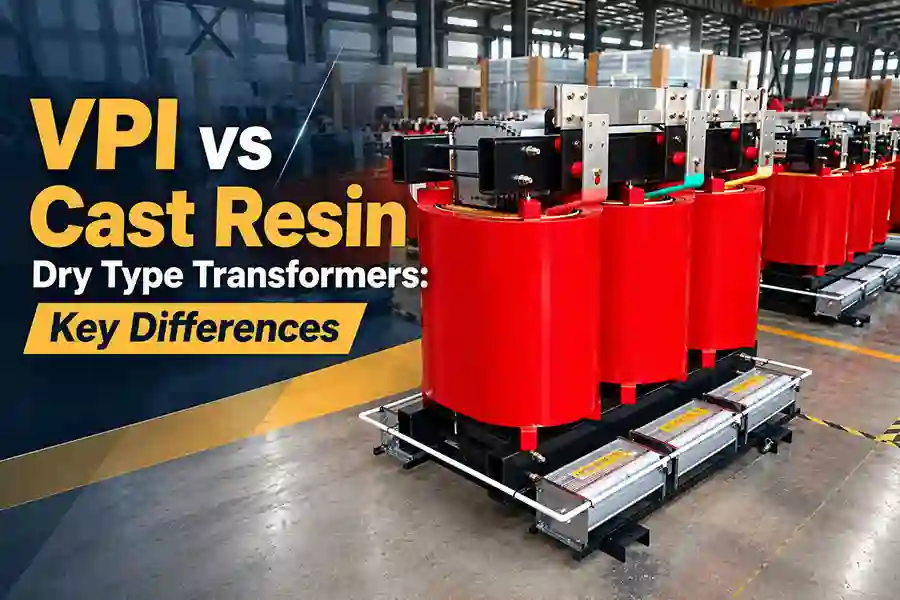
VPI and cast resin dry-type transformers differ principally in how their winding insulation is processed. VPI uses vacuum and pressure to impregnate the winding insulation with insulating varnish or resin, followed by curing. Cast resin construction uses resin casting and curing to form a solid insulation structure around the winding being cast.
That difference matters when comparing winding protection, cooling and maintenance. It does not, by itself, establish which offered transformer has lower losses or meets a particular site requirement. This guide focuses on medium-voltage distribution projects and follows a practical sequence: understand the construction, compare the offered ratings, then assess the installation. Huasheng’s SCB series is the cast resin product family discussed here.
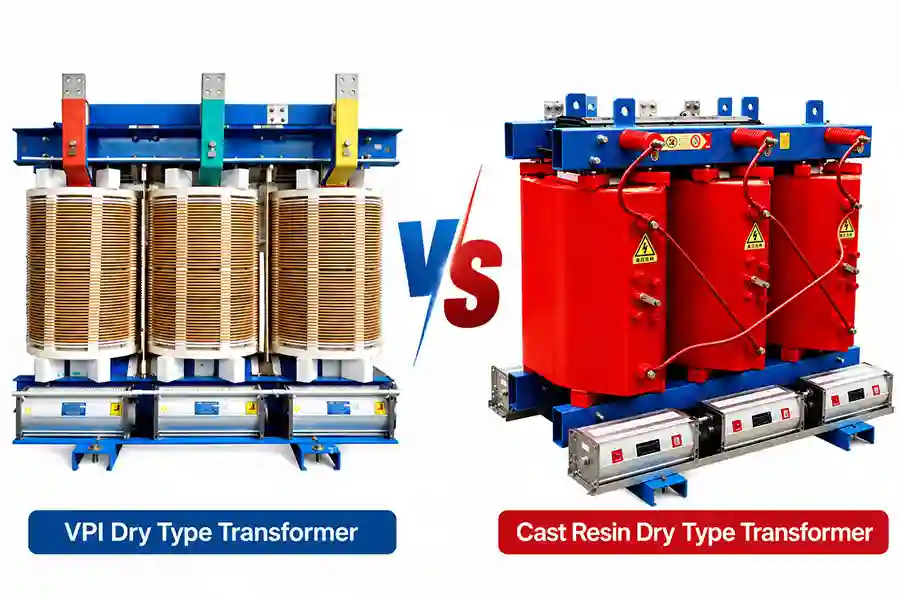
What Are VPI and Cast Resin Dry-Type Transformers?
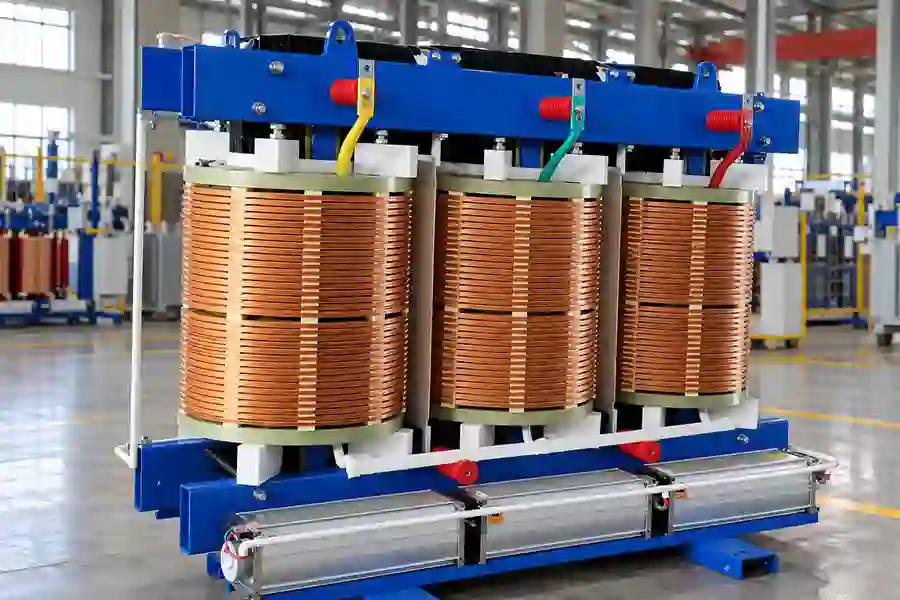
VPI Dry Type Transformers: Vacuum Pressure Impregnation
VPI stands for Vacuum Pressure Impregnation. In the manufacturing process described in the source material, prepared coils are dried, placed in a vacuum-pressure vessel, immersed in insulating varnish, subjected to pressure, drained and cured. The impregnant enters the winding insulation system; VPI is therefore not a resin-free or varnish-free construction.
The useful distinction is between impregnation and a moulded casting. A varnish film formed by impregnation should not be described as an identical structure to the cast-resin body of a moulded coil. The actual materials and winding treatment should be identified for the offered design.
Buyer’s check: ask the supplier to identify the treatment of the high-voltage and low-voltage windings separately. If a quotation uses “VPE” or “encapsulated,” request the actual construction description before treating it as equivalent to the VPI option. This is a terminology check, not a claim that every supplier uses those labels identically.
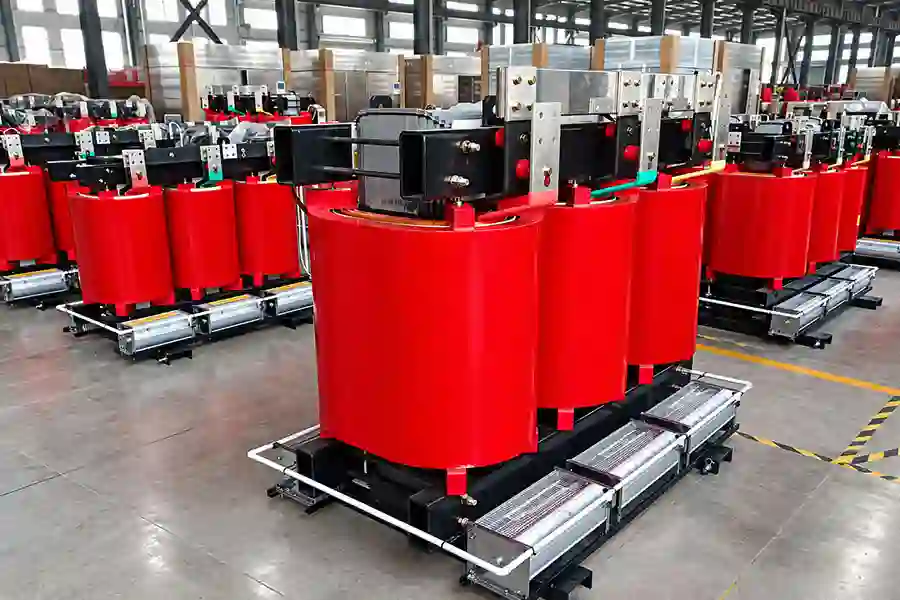
Cast Resin Transformers: Resin-Cast Winding Insulation
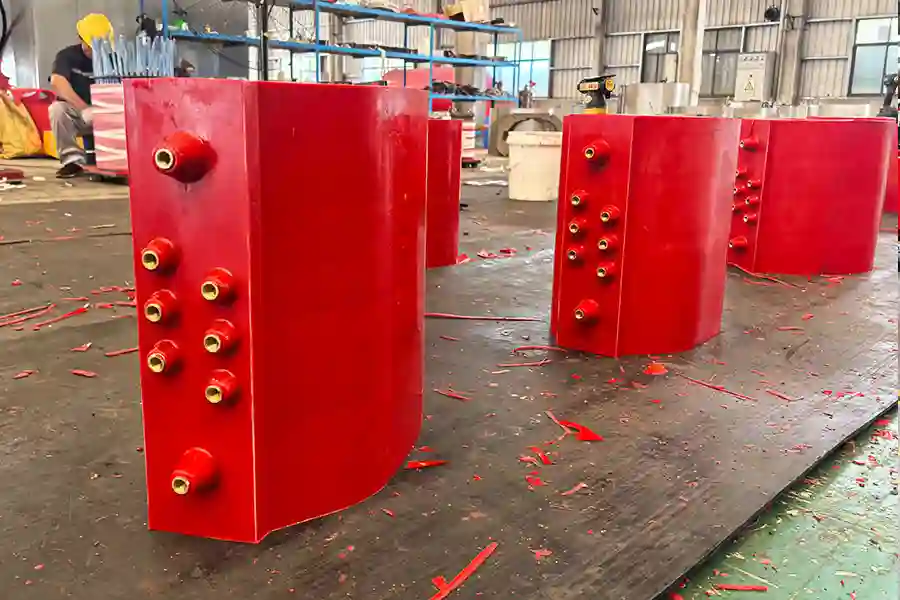
In cast resin dry transformers manufacturing, a wound coil is placed in a mould, prepared resin is introduced, and the casting is cured before demoulding. Vacuum processing is also used in resin casting to remove gas and reduce bubbles. The use of vacuum alone therefore does not make a casting process VPI.
Huasheng’s company brochure identifies the C in its SCB model description as epoxy resin casting and the B as a low-voltage foil winding. Its SCB11, SCB14 and SCB18 product documents also identify the products as epoxy cast resin dry-type transformers.
This establishes the product-family connection. It does not establish that every SCB model has identical high- and low-voltage encapsulation. For a detailed comparison, request the proposed winding construction drawing rather than inferring the full insulation arrangement from the SCB designation.
VPI vs Cast Resin Transformers: Key Differences at a Glance
| Comparison factor | VPI | Cast resin | Project implication |
|---|---|---|---|
| Winding insulation | Varnish/resin impregnation followed by curing. | Resin casting and curing form the cast insulation body. | Identify what is impregnated or cast on each winding. |
| Moisture and contamination | Protection depends on the offered insulation treatment and declared service conditions. | The cast body provides solid winding protection; environmental suitability still needs model-specific evidence. | Assess actual condensation, contamination and installation protection; do not assume waterproof construction. |
| Cooling and loading | Compare the offered cooling mode, temperature rise and capacity. | Compare the same fields, including the cast design’s air passages. | A thermal class is not an extra-load allowance. |
| Enclosure and room | Assess the complete unit and installation. | Cast insulation does not remove the need to assess enclosure and airflow. | Check access, ventilation and environmental exposure together. |
| Fire behaviour | Obtain evidence for the specified design and requirement. | Obtain equivalent evidence; cast resin is not an automatic fire classification. | Match the report to the offered product and project specification. |
| Efficiency and noise | Use guaranteed losses and acoustic data, where required. | Use the same comparison basis. | Avoid a technology-wide efficiency or noise ranking. |
| Partial discharge (PD) | Compare a model-specific test result and its conditions. | Compare the same test basis; do not infer a guaranteed value from resin casting. | Different models or test conditions cannot be ranked from a pC figure alone. |
| Maintenance and repair | Request the model-specific maintenance and repair plan. | Request the corresponding plan, including coil or assembly replacement. | Both require an operational plan; no universal repair ranking is established here. |
| Price and lifecycle cost | Compare a defined supply scope. | Include the casting design, tooling and agreed accessories. | No verified same-specification price dataset is available for a percentage comparison. |
How Do Moisture, Contamination and Installation Conditions Affect the Choice?
Moisture, Condensation and Contamination
Cast resin’s solid structure is a meaningful construction difference: it forms part of the winding’s electrical insulation and mechanical support. Those advantages should be explained as properties to evaluate in the offered design, rather than converted into a promise that all cast resin units tolerate any environment.
Humidity, condensation and contamination need to be assessed separately. Operating exposure must also be considered apart from transport and storage conditions. A project description of “high humidity” is therefore incomplete if it does not say whether condensation, salt-laden air or direct water exposure is expected.
Selection advice: for a site with condensation or pollution exposure, give greater weight to the supplier’s relevant environmental evidence and the complete protection arrangement. Keep a suitably documented VPI proposal under consideration; the insulation label alone does not justify rejecting every modern VPI unit.
A current transformer-maker page describes its own ventilated VPI designs for commercial and industrial applications. This does not establish Huasheng’s supply scope or prove either design’s environmental performance; it simply reinforces the need to assess the actual offered unit.
Indoor and Outdoor Installation
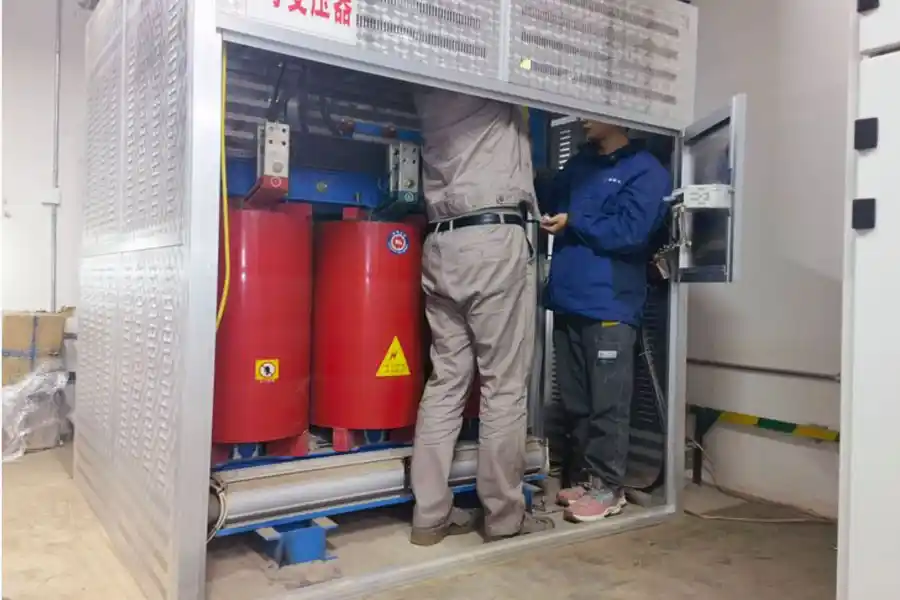
Winding insulation is one part of the installation. The source documents also address clearances, enclosures, cooling fans, access and ventilation. Huasheng’s SCB product material specifically calls for ventilation space and attention to dust and moisture during indoor installation.
For an outdoor proposal, request a declared outdoor configuration covering the enclosure, ventilation, exposure and installation conditions. A description such as “cast resin coil” or “VPI coil” does not provide that whole configuration. Likewise, define storage and shutdown conditions before agreeing on the required protection.
Hypothetical site checks — not Huasheng case studies: a hot room with dusty incoming air calls for a heat-removal and contamination review; a coastal room with recurring condensation calls for environmental and corrosion-protection review. These conditions can occur in different regions, so the Middle East or Southeast Asia should not be used as a substitute for actual site data.
| Site condition | Design or document to compare | If evidence is missing |
|---|---|---|
| Protected, clean indoor room | Cooling path, room ventilation and declared service conditions | Keep both proposals under review; do not select by label alone. |
| High inlet temperature with dust | Thermal rating, air path, enclosure and contamination protection | Request the design conditions and applicable evidence before confirming suitability. |
| Condensation or coastal salt exposure | Environmental classification/test scope, enclosure and corrosion measures | Record exposure and storage conditions; leave environmental suitability open. |
| Long shutdown or transport/storage exposure | Manufacturer’s storage and re-energization instructions | Obtain model-specific instructions; do not infer them from the insulation type. |
For a factory project, the industrial facilities application page is the next place to organize the load and installation context.
How Do Cooling, Efficiency and Fire Performance Compare?
Cooling, Temperature Rise and Loading
Insulation thermal class and winding temperature rise describe different things. Thermal class identifies the insulation system’s temperature classification. Temperature rise describes how much warmer the measured part becomes than its cooling medium. Natural-air and forced-air cooling must also be identified separately.
The cooling system must dissipate the heat produced by losses while the winding temperature rise remains within the specified limit. This links thermal performance to the complete design and operating conditions, not just to the insulation label.
Selection advice: compare declared capacity, cooling mode, ambient conditions, winding temperature rise and load duty together. If fans are included, identify the rating with and without their operation. Do not subtract one temperature figure from another to create an overload allowance.
Efficiency and Guaranteed Losses
No-load loss and load loss should be separate quotation fields. No-load losses occur mainly in the core whenever the transformer is energized. Load losses arise chiefly in the windings and increase with loading. Both components need to be considered when comparing operating performance.
For bid evaluation, compare the proposed units at the same project duty and clearly stated reference conditions. Review differences in core design, conductor, cooling and loss guarantees rather than assigning an efficiency advantage to VPI or cast resin as a whole. Treat noise in the same way: request a declared value and its measurement basis when the project requires it.
Fire Behaviour and Project Requirements
IEC 60076-11 addresses dry-type transformers and includes environmental, climatic, thermal and fire-behaviour considerations. A material’s burning-performance claim does not, by itself, establish the fire behaviour of a complete Huasheng transformer.
For an indoor project, request the fire-behaviour evidence required by the specification and confirm its applicability to the offered design. Neither “oil-free” nor an insulation thermal-class letter should be used as a substitute for that evidence. E/C/F environmental, climatic or fire classes are separate from IP enclosure protection and insulation thermal class; do not treat them as interchangeable, or convert an IP figure into a fire rating. Building-level fire measures remain a project design question rather than a conclusion made from the coil name.
What Are the Differences in Maintenance, Repairability and Service Life?
Routine Inspection and Maintenance
Dry-type maintenance still includes checking the windings, air passages, connections and cooling equipment. Siemens Energy’s operating instructions include inspection and cleaning requirements for its cast resin transformers, while Huasheng’s product material includes temperature-control and fan checks.
For either proposal, obtain a maintenance schedule that fits the installation. The useful comparison is the required work, access and shutdown arrangements. A cast winding should not be used to justify deleting inspection tasks, and VPI should not automatically be assigned a fixed higher maintenance burden.
Repair, Coil Replacement and Service Planning
Before choosing a unit, ask each supplier what happens if a winding or accessory is damaged. Request the repair location, replaceable assemblies, spare availability and the work included in the service arrangement. These are procurement recommendations; the evidence reviewed does not establish a universal field-repair or replacement advantage for either technology.
A repair decision should be based on the actual fault and the manufacturer’s assessment. The insulation type alone does not show whether a particular unit can be repaired on site or needs a replacement coil or assembly.
Operating temperature, time and loading affect insulation ageing. This supports reviewing loading and cooling during service planning, but it does not establish a fixed lifespan for either technology.
VPI vs Cast Resin Transformer Cost: What Should Buyers Compare?
Compare equipment prices only after defining the same electrical duty and supply scope. A non-standard cast resin product may require additional design and mould work. That is a reason to inspect the quote’s scope, not evidence of a fixed premium over VPI.
Bid-comparison advice: list the included enclosure, cooling equipment, controls, tests, drawings, packaging, transport and service. Then assess operating cost using the actual load profile, energized hours, tariff and maintenance assumptions. The loss data needed for that exercise should come from the offered designs.
A lower initial quote and a lower lifecycle cost are different comparison results. No purchase-price range, percentage saving or payback period is calculated here because the required comparable quotations and operating inputs are unavailable.
Which Is Better for Your Application: VPI or Cast Resin?
IEC-Based Projects in the Middle East and Southeast Asia
First check whether the tender, utility or approved design names a winding construction. If it does, treat an alternative as a technical deviation and obtain the responsible project approval. IEC is a standards framework; local adoption, utility rules and contract editions still need to be confirmed separately. Use actual site data for heat, condensation, dust and salt exposure rather than assigning default climates to a region.
North American Projects
Keep the comparison tied to the project-specified IEEE/ANSI documents, editions, ratings, enclosure, tests and any required listing or certification. Confirm the required editions and request certification or listing documents covering the proposed SCB model where the project requires them; do not infer compliance from an IEC reference or another manufacturer’s listing.
Selection framework — the rows below are hypothetical project conditions, not field-test results or Huasheng delivery cases. The decision directions are editorial recommendations based on the construction, environmental and thermal considerations discussed above.
| Project situation | Practical selection direction | What is still needed |
|---|---|---|
| Clean, protected indoor room | Compare both proposed designs on guaranteed performance, cost and maintenance. | Defined ratings, room conditions and comparable supplier data. |
| Condensation or contamination exposure | Give more weight to insulation protection, environmental evidence and complete installation measures. | Exposure description, applicable reports, enclosure and storage details. |
| High inlet temperature or restricted ventilation | Resolve heat removal and loading before choosing by insulation name. | Thermal data, cooling ratings and room arrangement. |
| Data center or other critical facility | Do not presume either insulation method is the default. Assess the electrical room, heat removal, duty and project reliability design. | Load profile, UPS/harmonic conditions, redundancy, cooling and specification. |
| Tender specifies a construction | Check the offer against the specification; submit an alternative as a deviation for project approval. | Contract requirements and approval procedure. |
| Cast resin selected for further evaluation | Review a Huasheng SCB proposal against the same electrical, environmental and document requirements. | Current SCB datasheet, drawing and applicable reports. |
Huasheng SCB product documents describe industrial, commercial and indoor distribution applications. That makes the series a relevant product family to evaluate once the project is considering cast resin construction. Suitability still belongs to the actual configuration and approved project requirements.
If the earlier choice between liquid-filled and dry-type equipment is still unresolved, use the existing oil-immersed vs dry-type comparison first.
What Should You Verify Before Ordering?
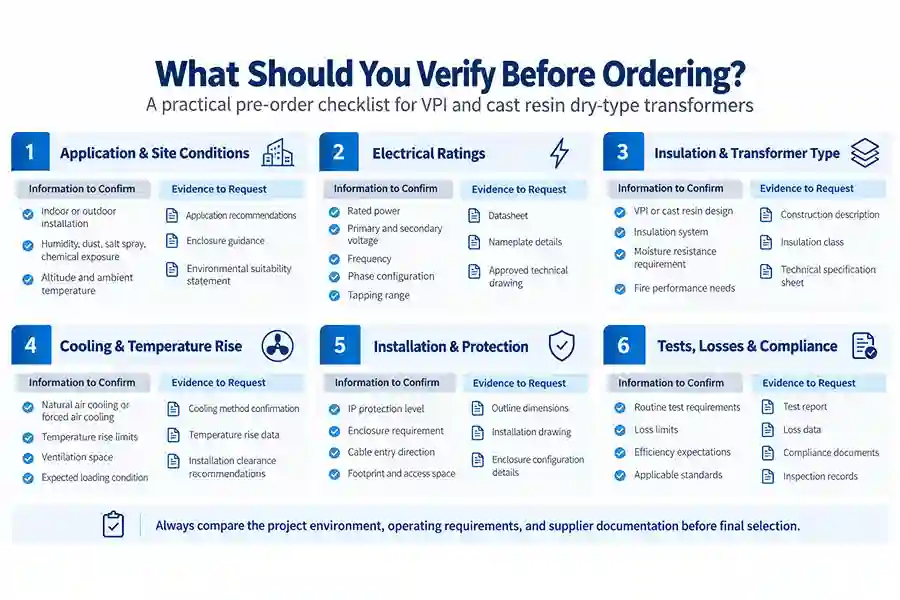
Send both suppliers the same requirement schedule and ask them to distinguish the required condition, guaranteed value, supporting document and any deviation. The technical fields below provide a common basis for comparing proposals; document and scope checks are procurement recommendations.
| Requirement group | Information to establish | Evidence to request |
|---|---|---|
| Electrical ratings | kVA/MVA, rated and highest system voltage, frequency, phase, vector group, impedance and tap range. | Rating schedule and proposed nameplate data. |
| Duty | Load profile, harmonics, starting/transient conditions, continuous and short-time duty. | Load list/SLD and any design assumptions. |
| Winding and thermal design | HV/LV insulation construction, thermal class, temperature rise, cooling mode, fan/no-fan ratings and guaranteed losses at the stated reference conditions. | Construction drawing, guaranteed data and applicable thermal/loss test reports. |
| Insulation and fire evidence | PD result and test conditions, insulation withstand tests, requested environmental/climatic/fire classification. | Reports/declarations tied to the offered model and project requirement. |
| Site and enclosure | Inlet temperature, altitude, condensation, dust/salt/corrosion exposure, enclosure, ventilation, noise and access. | Site data and approved arrangement/enclosure drawings. |
| Standards and tests | Standard names/editions, routine/type/special test scope and acceptance criteria. | Contract compliance/deviation schedule and applicable reports. |
| Interfaces and service | Dimensions, cable/busbar orientation, terminals, accessories, maintenance, repair and spare/coil replacement scope. | Approved drawings, model-specific manual and written service scope. |
| Commercial scope | Currency/date, included accessories/tests/documents, packaging, transport, delivery terms and service. | Like-for-like quotation and stated exclusions. |
Frequently Asked Questions
Q1: Can a VPI transformer be replaced with a cast resin transformer?
Treat it as a replacement design review. Matching kVA alone does not address winding voltages, impedance, connections, dimensions, terminals, cooling or the project specification. Check these electrical and installation fields separately. Different rated voltage arrangements are not automatically interchangeable.
Q2: Can VPI and cast resin transformers be used outdoors?
Either proposal must be assessed as a complete unit with its enclosure, cooling arrangement, declared environment and project requirements. The winding-insulation label alone does not establish outdoor suitability.
Q3: Does a higher insulation class mean more overload capacity?
No. Thermal class, temperature rise, ambient conditions, cooling and load duration are separate design conditions. Use the model’s rated data and loading guidance; do not calculate overload headroom by subtracting temperature figures.
Conclusion
Choosing between VPI and cast resin starts with the winding construction, but the final choice must also reflect project ratings, site conditions, cooling, testing requirements and service plans. Compare both proposals on the same basis, and verify each guarantee against model-specific documents.
Huasheng offers cast resin SCB dry-type transformers. Send your SLD, technical specification and site data to discuss a project-specific configuration.
References
- Virginia Transformer — Product-specific ratings and proprietary claims apply to that manufacturer’s designs.
- Hitachi Energy — Open Wound Transformers. Describes its VPI and VPE constructions, including polyester-varnish impregnation and commercial or industrial applications.
- Siemens Energy — GEAFOL/CARECO Cast-Resin Transformer Operating Instructions. See page 8 for winding construction, sections 5.6 and 5.13 for storage and ventilation, and sections 8–9 for inspection, cleaning and fault support. Instructions apply to the products covered by the manual.
- International Electrotechnical Commission — IEC 60076-11:2018 Official public catalogue describing the standard’s scope and topics, including environmental, climatic, thermal and fire-behaviour considerations.
- International Electrotechnical Commission — IEC 60076-12:2008. Official scope explains the relationship between transformer loading, operating temperature, time and insulation ageing.
- U.S. Department of Energy — Energy Conservation Standards for Distribution Transformers, 2024.
Related Product:
- Pole Mounted Transformers Buying Guide: Specs and Costs
- High Voltage Power Transformers Guide: How to Select?
- How to Choose a Single Phase Pole Mounted Transformer?
- 1000 kVA Oil Filled Transformer: You Need Know
- Top 16 Power Transformer Manufacturers in World
- Oil Type Transformer for Distribution Projects: When Choice?
- Padmount Transformer Guide: Types, Sizing, Specifications
- Single Phase Transformer Guide: Types, Applications, Sizing
- Three Phase Transformer Guide: Connections, Sizing, and Principles