Power Distribution Transformer Solutions
Engineering SupportGlobal Project Supply

Pole Mounted Transformers Buying Guide: Specs, Selection and Costs
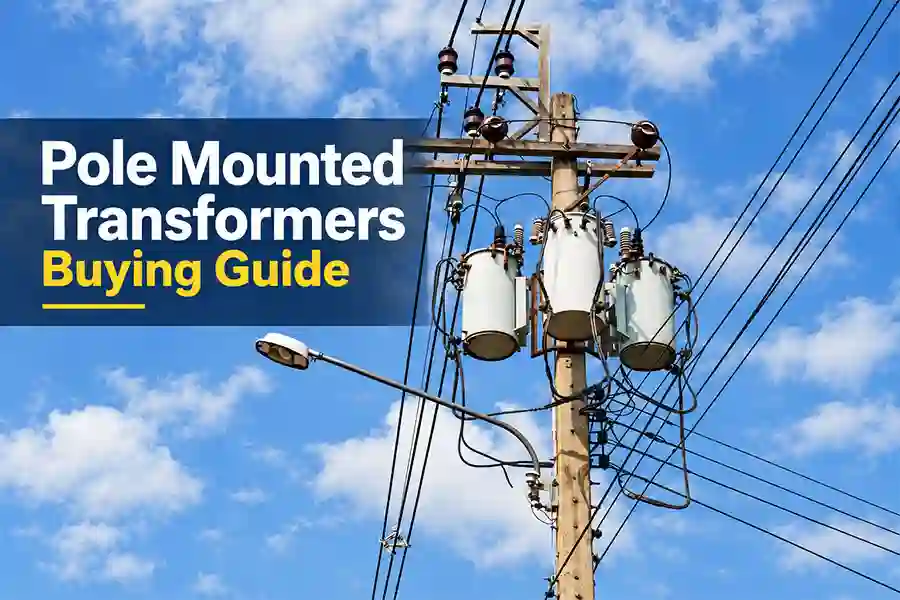
Pole mounted transformers reduce distribution-line voltage to the level required by local loads. Selecting a pole mount transformer requires matching its phase, voltage, frequency, load capacity and mounting arrangement to the project.
An overhead power project needs more than the right price per unit. The pole mounted distribution transformer must match the supply, serve the load and fit the pole structure. Freight, protection and test records also shape the real cost.
This guide covers Huasheng single-phase and three-phase pole mounted transformers. It can supply practical guidance on specifications, quotation comparison and procurement for utilities, contractors and distributors purchasing equipment from China.
What Is Pole Mounted Transformer?
A pole-mounted transformer is a distribution transformer installed on a utility pole or pole-supported platform. It step-down distribution-line voltage. Like steps high-voltage electricity down to a lower voltage for homes, farms, and small businesses.
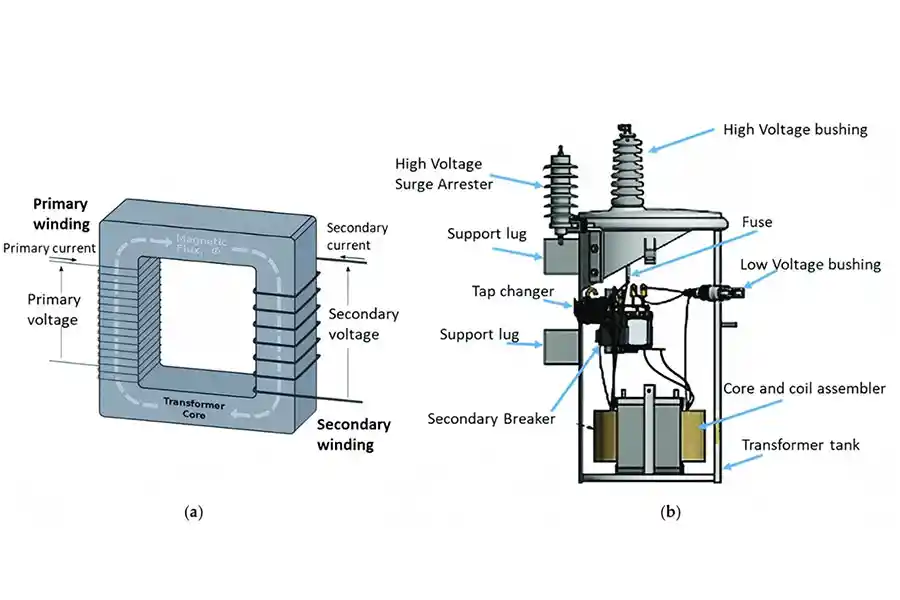
A pole-mounted transformer contains a core, winding, and oil-filled tank. Inside, alternating current in the primary winding creates a changing magnetic field in the core. This induces voltage in the secondary winding. The winding turns ratio sets the nominal voltage ratio.
These products covered in this guide are oil-immersed. Their oil insulates live parts and carries heat away from the core and windings.
You see these units on utility poles along streets and rural roads. They hang from a bracket or mounting platform. The secondary side supplies 120–240 V for residential loads or 277/480 V for light commercial use.
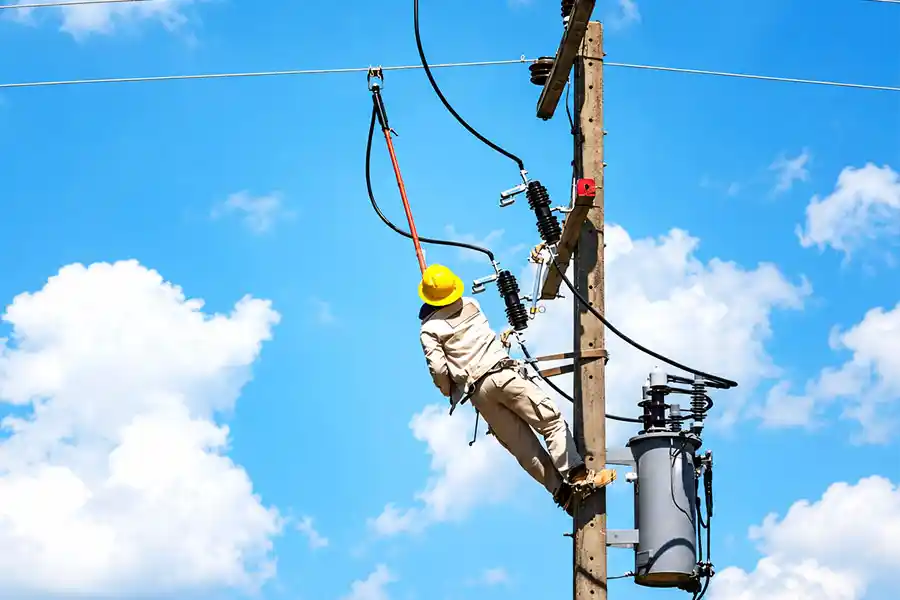
Huasheng Real Project Cases: Pole-Mounted Transformer Send To Philippines
This project is a rural electrification project in the Philippines. Huasheng factory supplys custom overhead distribution transformers. Total 20 pieces, Use it to judge whether a similar approach fits your own requirements.
Project Requirements and Quoted Configuration
The quoted specifies below reflects one specific Philippines project. Your project may need different ratings or materials.
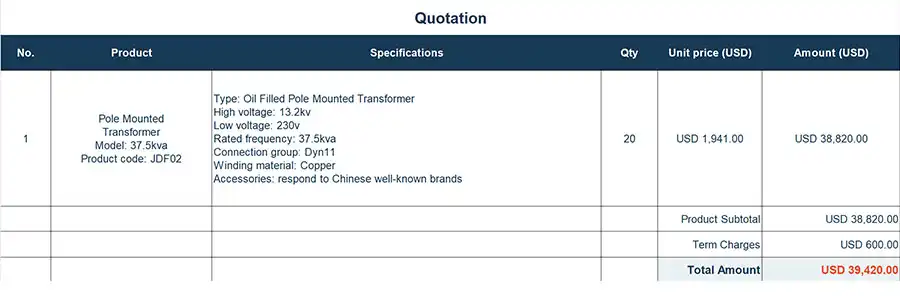
The customer needed single-phase 37.5 kVA units with a 13.2 kV primary, a 230 V secondary and copper windings. configuration was as follows:
| Item | Quoted detail |
|---|---|
| Project market | Philippines |
| Product | Single Pole-mounted distribution transformer |
| Rated capacity | 37.5 kVA per unit |
| Primary High voltage | 13.2 kV |
| Secondary Low voltage | 230V |
| Winding material | Copper |
| Insulating medium | Oil |
| Connection group | Dyn11 |
| Quantity | 20 units |
Phase, frequency and winding connection must be confirmed in the final approved data sheet. Use this as a comparison point. Check your own capacity, voltage and quantity requirements. Where your project differs, note those items for the inquiry.
How Much About 37.5 kVA Single-phase Pole Transformers Cost?
The project quote lists 20 pieces single phase pole oil-filled transformers at USD 1,941 each, with an equipment subtotal of USD 38,820.
This gives the price a clear basis: a stated rating, material and quantity. The case below uses the quotation as its cost record.
The quoted equipment subtotal is USD 1,941 × 20 units = USD 38,820.
It does not include freight, insurance, import duties, installation, or site-related costs. Those items require separate confirmation based on the delivery location and project scope.
Use this case as a reference for one proposed order. When you compare this with other offers, make sure you are comparing the same configuration and scope. A lower unit price may exclude items that the original quotation included. A higher price may include more testing or packaging.
For a similar project, Send Huasheng your capacity, voltage, quantity and delivery location to get a quotation that matches your project.
Pole-mounted transformer Types: Single-phase, Thress-phase
Pole mount transformer has two types: single phase transformers and three phase pole mount transformers. Which type fits your power distribution system. You should choose the phase arrangement that matches the supply and loads.
Choose Single-Phase Oil-Immersed Pole-Mounted Transformers
A single-phase pole-mounted transformer serves one phase of a distribution line and steps voltage down for residential or light commercial loads. Choose a single-phase transformer when the required service and connected loads use single-phase power.
The unit mounts on a utility pole. It has an oil-filled tank that cools the core and winding. High-voltage bushings connect to the distribution line. A fuse or cutout and surge arresters protect against overcurrent and lightning strikes. Grounding connects the tank and neutral to earth. The secondary side supplies 120–240 V for homes, farms and small businesses. Single-phase pole-mounted transformers are common where three-phase service is not available or not needed.
Read Related Article Learn More Details: How to Choose Single Phase Pole Mounted Transformer?
Choose Three-phase Oil-immersed Pole Mount Transformers?
A three-phase pole-mounted transformer serves three-phase loads and connects to a three-phase supply system. Choose a three-phase transformer when the supply and project loads require three-phase service.
These units are larger and heavier than single-phase models. They use three-phase windings and high-voltage bushings. They serve commercial buildings, pumps, light industrial workshops and small three-phase motor loads. Three-phase pole mount configurations exist in several voltage classes.
Three-phase service can also come from a bank of separate single-phase units. Eaton’s transformer guide describes this arrangement. If the project calls for a bank, confirm the unit ratings, bank rating and connections.
A bank of single-phase units is not the same as a three-phase units. Each approach has different wiring, protection and footprint needs.
Read Related Article Learn More Details: Three-phase Transformer Buying Guide
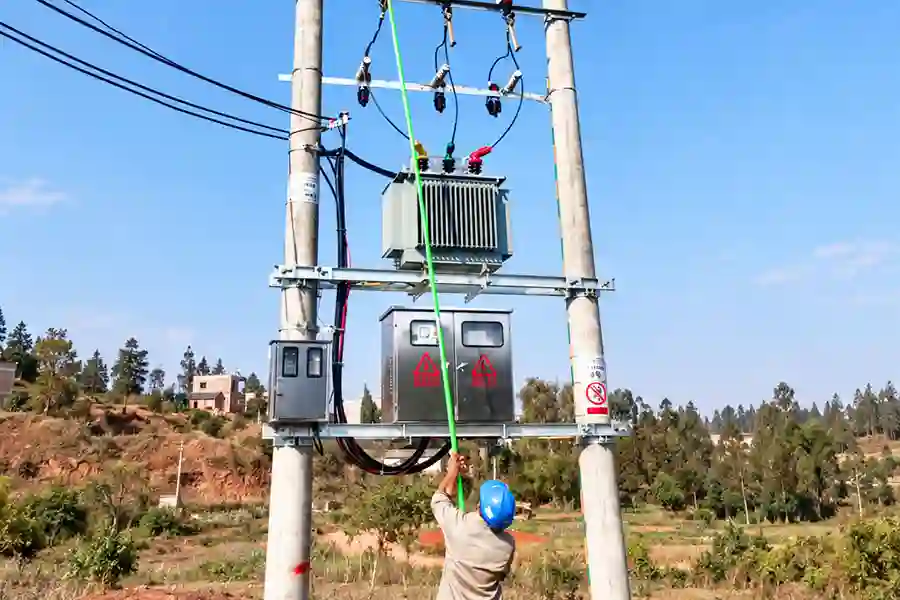
Which Configuration Fits Your Project for This Two Phase.
Match your supply system and load type to the transformer configuration before you compare prices.
| Factor | Single-Phase | Three-Phase |
|---|---|---|
| Supply system | One phase of a distribution line | Three-phase supply |
| Typical load | Homes, farms, small shops | Commercial buildings, light industrial |
| Secondary voltage | 120–240 V | 208Y/120 V, 277/480 V or project-specific |
| Installation | Smaller pole hardware | Heavier pole, larger brackets |
| Winding | Two-winding, single-phase core | Three-phase core or bank |
| Information needed | Primary voltage, kVA, tap range | Vector group, kVA, voltage ratio |
The number of support poles does not tell you the number of electrical phases. A two-pole platform describes a mounting structure.
Select the electrical arrangement first. Then check whether the utility pole or platform can support the proposed unit and meet the project’s installation requirements.
Which Pole-mounted Transformers Specifications Should You Compare?
Compare voltage, phase, capacity, losses, weight and mounting details for the exact design you plan to order.
Treat each data set as a complete design reference. The two single-phase tables below cover different primary voltages. They are separate from the 13.2 kV configuration in the Philippines quote.
Huasheng CON Type Single-Phase Transformer Specifications Show
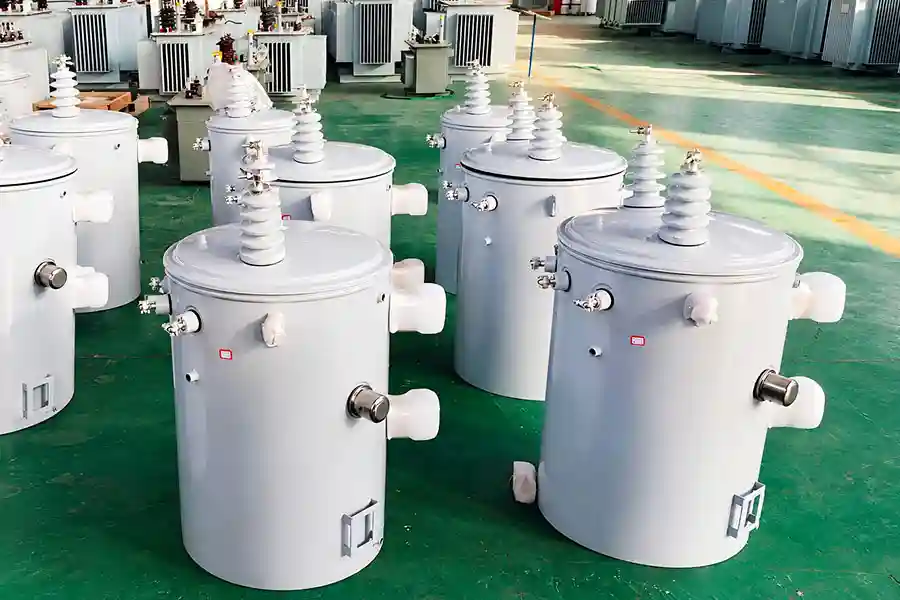
The two CRGO tables list 15–167 kVA single-phase units for 7.97 kV and 19.92 kV primary ratings.
These tables cover the CON-type single-phase designs in Huasheng’s catalog. CRGO means cold-rolled grain-oriented silicon steel, a material used for transformer cores. Both tables list a low-voltage range of 120–240 V. Confirm the exact secondary connection on the approved drawing.
Table 1. CRGO-Core Single-Phase Transformer Specifications — 7.97 kV Primary
Common configuration:
- Transformer type: Single-phase, CON type
- Core material: Cold-rolled grain-oriented silicon steel — CRGO
- Primary voltage: 7.97 kV
- Secondary voltage: 120–240 V
- Tap arrangement: +1/−3 × 2.5%
| Rated capacity (kVA) | No-load loss (W) | Full-Load Loss (W)* | Oil weight (kg) | Total weight (kg) |
|---|---|---|---|---|
| 15 | 55 | 140 | 51 | 176 |
| 25 | 73 | 240 | 68 | 231 |
| 37.5 | 101 | 331 | 86 | 288 |
| 50 | 115 | 430 | 96 | 337 |
| 75 | 152 | 600 | 114 | 425 |
| 100 | 181 | 900 | 144 | 504 |
| 167 | 266 | 1,400 | 197 | 753 |
Table 2. CRGO-Core Single-Phase Transformer Specifications — 19.92 kV Primary
Common configuration:
- Transformer type: Single-phase, CON type
- Core material: Cold-rolled grain-oriented silicon steel — CRGO
- Primary voltage: 19.92 kV
- Secondary voltage: 120–240 V
- Tap arrangement: +0/−4 × 2.5%
| Rated capacity (kVA) | No-load loss (W) | Full-Load Loss (W)* | Oil weight (kg) | Total weight (kg) |
|---|---|---|---|---|
| 15 | 55 | 140 | 72 | 210 |
| 25 | 73 | 240 | 86 | 255 |
| 37.5 | 101 | 331 | 104 | 311 |
| 50 | 115 | 430 | 119 | 368 |
| 75 | 152 | 600 | 148 | 485 |
| 100 | 181 | 900 | 153 | 537 |
| 167 | 266 | 1,400 | 205 | 784 |
“Full-Load Loss” preserves the source table’s label. Confirm whether it means load loss alone or total loss at full load before using it in a cost calculation.
These are catalog reference values. Confirm frequency, test conditions, permitted tolerances and final weights for the ordered design. Obtain a separate outline drawing for dimensions and mounting details.
Amorphous cores for lower no-load losses: An amorphous core offers another option. Metglas reports up to about 70% lower no-load losses compared with conventional silicon-steel designs. Compare guaranteed values at matching capacity, voltage, frequency and test conditions. This reduction concerns core loss, not the whole electricity bill. Ask for both no-load and load losses when comparing the two core materials.
Technical Clarifications: What does +1/−3 × 2.5% mean?
It lists one 2.5% step above nominal and three 2.5% steps below nominal. The range is therefore +2.5% to −7.5% on the rated tap schedule. Use the nameplate to match each switch position to its voltage. This marking does not confirm on-load tap changing. For an off-circuit tap switch, follow the supplied de-energized procedure.
Which Three-Phase Ratings Should the Supplier Confirm?
A three-phase offer needs its own data sheet for the requested voltage, connection and capacity.
Request these values for the proposed design:
- Rated capacity, phase and frequency.
- Primary and secondary voltages, with line-to-line or line-to-neutral values clearly named.
- Winding connection, vector group and neutral arrangement.
- Tap range and tap positions.
- Guaranteed no-load loss, load loss and impedance.
- Required insulation level and temperature rise.
- Oil quantity, filled weight and overall dimensions.
Ask which values belong to an existing design and which require changes. List any difference from the project specification in the offer. That lets you review a proposed alternative before it becomes part of the order.
Click Here to See More Three Phase Oil-Immersed Transformers Details
Which dimensions and accessories must match the site?
The filled weight, bracket spacing and terminal positions must fit the approved support layout.
Request an outline drawing with mounting points, lifting points and bushing positions. Check the high- and low-voltage cable routes against the site layout. The drawing should also show the space needed around the unit.
List the fitted accessories by name. These may include grounding terminals, a pressure relief valve and a tap device, depending on the design. Identify external items, such as a fuse cutout and low-voltage protection, on a separate supply list.
How to Select a Pole-Mounted Transformer for Your Electrical Distribution Project
Start with the supply details, then check running loads, motor starts and site limits.
Write down unknown items early. A clear question during quotation is easier to resolve than a missing connection detail after production.
Selection means matching the system, the load and the site to the transformer. This section helps you build a technical requirement you can submit.
Which supply details must be confirmed first?
Confirm primary voltage, secondary voltage, phase, frequency and the utility’s connection rules before choosing capacity.
For each voltage, state which terminals it is measured between. A line-to-line value and a line-to-neutral value describe different connections.
Include the required service voltage, frequency in hertz, neutral needs and permitted voltage variation. Add the utility specification and the required standard, with its edition.
For a basic load estimate:
- Single phase: kVA = volts × amperes ÷ 1,000.
- Balanced three phase: kVA = √3 × line-to-line volts × line amperes ÷ 1,000.
These formulas estimate apparent power. Schneider Electric’s sizing guidance also notes that basic calculations do not cover special load needs, such as motor starting. Use the load profile to complete the selection.
How do motor starts change the required capacity?
Check the hardest start with other loads running before you settle on the transformer rating.
Send the motor nameplates, starting methods and operating schedule. Include the loads that stay on while each large motor starts.
Review three conditions:
- The normal peak running load.
- The largest expected motor start with other equipment operating.
- The restart sequence after a power outage.
For example, one pump may start while two other pumps keep running. After an outage, the controls may try to restart all three. Those events place different demands on the supply.
Schneider Electric’s motor-starting guidance links starting voltage drop to motor current, other loads, transformer impedance and the upstream supply. Ask for the sizing assumptions and the expected starting-voltage result. This gives you a reason for the proposed capacity.
Specify Site Conditions and Installation Constraints
Site conditions affect the transformer design, paint system and accessories. If possible State the actual heat, altitude, weather exposure and mounting limits in the inquiry.
Record these factors for your project:
| Site Factor | What You Provide | What the Supplier Confirms |
|---|---|---|
| Ambient temperature | Min/max °C | Temperature rise design |
| Altitude | Meters above sea level | Insulation coordination |
| Coastal exposure | Distance to sea, salt spray | Corrosion protection |
| Humidity | Average and peak | Tank sealing, breather type |
| Dust or contamination | Type and level | Bushing creepage distance |
| Installation space | Pole type, clearances | Outline dimensions, bracket fit |
| Seismic or wind | Project location requirements | Mechanical design |
IEC 60076-7 addresses how temperature and loading affect the life of mineral-oil-immersed transformers. Site conditions therefore belong in the selection data.
Ask the supplier to state its design response to each site requirement. This may cover the coating, insulation, cooling limits or fittings.
Grounding and protection must also match the local system. Have the utility or project engineer define the required arrangement, then agree who supplies each part.
What Determines Pole-mounted Transformer Prices and Project Costs?
Compare the price of the same approved equipment and delivery scope, then assess running costs.
Keep three amounts clear: the equipment price, the cost to deliver and install it, and the cost of its losses during use. The Philippines case supplies a reference for the first amount.
Why can transformers with the same kVA have different prices?
Equal capacity can hide differences in materials, losses, insulation, fittings and supply scope.
Review the items behind each price:
- Windings: copper or aluminum, as specified for the design.
- Core: CRGO or amorphous material, with stated loss values.
- Electrical requirements: voltage rating, insulation level and tap range.
- Tank and fittings: coating, mounting details, terminals and accessories.
- Order requirements: tests, reports, quantity and packing.
Ask the supplier to explain price changes against named items. For example, a lower-loss core should come with lower guaranteed no-load loss, not just a material label.
List proposed changes to the specification in writing. This lets you decide whether an alternative meets the project’s needs and earns its price.
What should the equipment quote include?
The quote should name every supplied item and every item left for the site team.
| Cost group | Scope to confirm |
|---|---|
| Transformer | Core, windings, oil, tank, bushings, nameplate and fitted accessories |
| External protection | Fuse cutout, surge arresters, secondary protection and any specified switchgear |
| Support hardware | Brackets, crossarms, platform, poles and fasteners, where required |
| Site connections | Conductors, connectors, insulators and external grounding materials |
| Tests and documents | Agreed tests, reports, drawings and any witness arrangements |
| Export and transport | Packing, named delivery point, freight, and any included customs duties or taxes |
This list sets the scope; it does not mean every item comes with every transformer.
Have the project engineer review protection ratings and how the devices work together. Hubbell’s transformer protection note explains the role of fuse time-current curves in protecting equipment while limiting needless outages. A fuse selection needs more than a capacity label.
How should you compare quotations and running costs?
Compare matching designs first, then add delivery charges and the cost of their losses.
Use one comparison sheet:
- Match voltage, phase, capacity, connections and test requirements.
- Add any missing accessories or documents to each offer.
- Compare the cost to the same delivery point.
- Assess losses using the same operating hours, load profile and energy price.
For a simple illustration, assume a 50 W reduction in no-load loss over 8,760 energized hours:
50 W × 8,760 hours ÷ 1,000 = 438 kWh saved per year.
At an assumed USD 0.10/kWh, that equals USD 43.80 per unit per year. This is an illustration, not a measured result from the Philippines project.
Load losses need a separate calculation based on the load profile. Confirm the meaning of every loss figure first. In particular, do not add no-load loss to a “Full-Load Loss” figure until the supplier confirms what that figure includes.
Use the estimated annual savings to assess any extra purchase cost.
How to Verify Transformer Quality Before Ordering?
Turn each performance claim into a stated value, a test requirement or a document you can check.
Keep the technical offer, approved drawings and test schedule tied to the purchase order. This gives both sides a shared basis for review.
Which Guaranteed Values Belong in the Technical Offer?
The offer should state the promised ratings, losses, impedance and test basis for the exact design.
Check that the data sheet covers the requested phase, voltage, frequency, connection, materials and fittings. Record the required insulation level and temperature rise. Mark loss figures as guaranteed or typical.
Specify the governing standard and edition. IEC 60076-1 covers general requirements for transformers within its scope. If the project calls for IEEE requirements or a utility specification, name those documents in the order. A broad standards claim does not settle the contract’s test scope.
Agree on permitted tolerances and list all deviations. Review the nameplate and connection drawing with the data sheet so their ratings and terminal details agree.
Which Tests and Documents Should You Request?
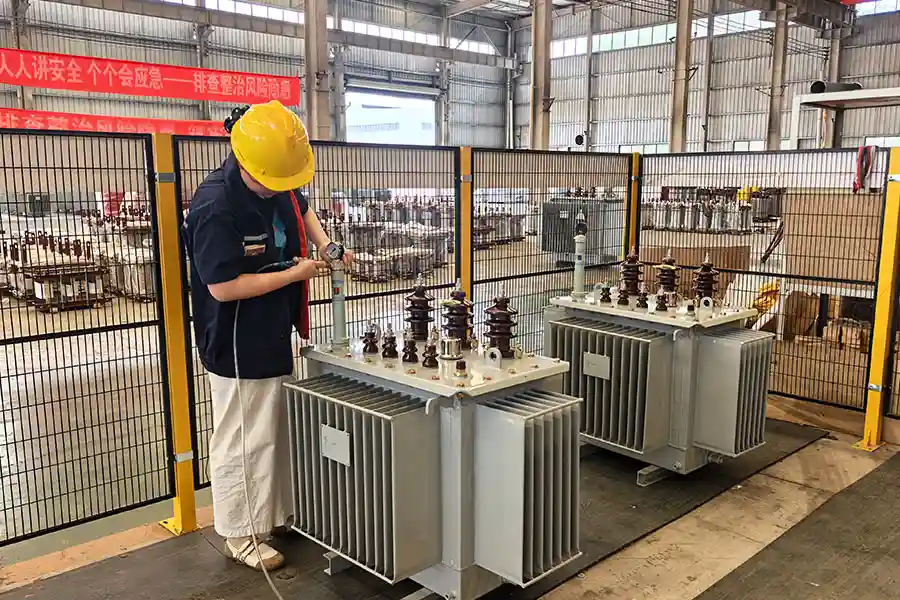
Agree on the tests, acceptance limits and reports before the order enters production.
Depending on the design and governing standard, the test schedule may include:
- Voltage ratio and polarity or phase-relation checks.
- Winding resistance.
- No-load loss and no-load current.
- Load loss and impedance.
- Required dielectric tests.
- Tank leak checks.
Ask which tests apply to each unit and which use evidence from a representative design. Eaton’s test overview separates production tests from design tests.
Reports should identify the unit or design, test date, conditions, results and acceptance limits. Arrange witness points before production if the project requires them.
Factory reports and site acceptance serve separate tasks. The site team must still plan its required checks before the equipment enters service.
Keep Specifications Consistent Across Repeat Orders
Repeat orders need the same drawing revision, specification and nameplate requirements.
When you place a repeat order, refer to the approved drawing, the technical specification and the confirmed nameplate data from the first order. If any item changes, confirm it in writing before production. Track the drawing revision number and the date of approval.
For distributors with custom nameplate requirements, keep a controlled copy of the approved nameplate drawing. Confirm the serial number format, the rating markings and the language requirements. If the utility specification changes, update the technical file before the next order. This keeps the replacement unit compatible with the installed base.
Delivery, Packaging and Warranty for Overseas Buyers
Delivery discussions need a clear start and end point. Packaging, handover documents and warranty terms should be confirmed during procurement.
Which milestones make the delivery schedule useful?
Normal transformer manufacturers calculate delivery time from the date they receive the advance payment. Therefore, you need to consult the supplier for the specific delivery date.
Then record the main stages:
- Technical review and drawing approval.
- Material preparation and production.
- Factory tests and report review.
- Packing and shipment release.
- Dispatch, transit and arrival at the agreed point.
Separate manufacturing time from transit time. Add deadlines for buyer comments, inspection visits and any required approvals.
Huasheng Transformers Company usual delivery time is 30 days, but for very large projects, it may take up to 60 days.
Confirm Export Packaging and Handover Documents
Confirm transport protection, handling data and the documents needed at the destination.
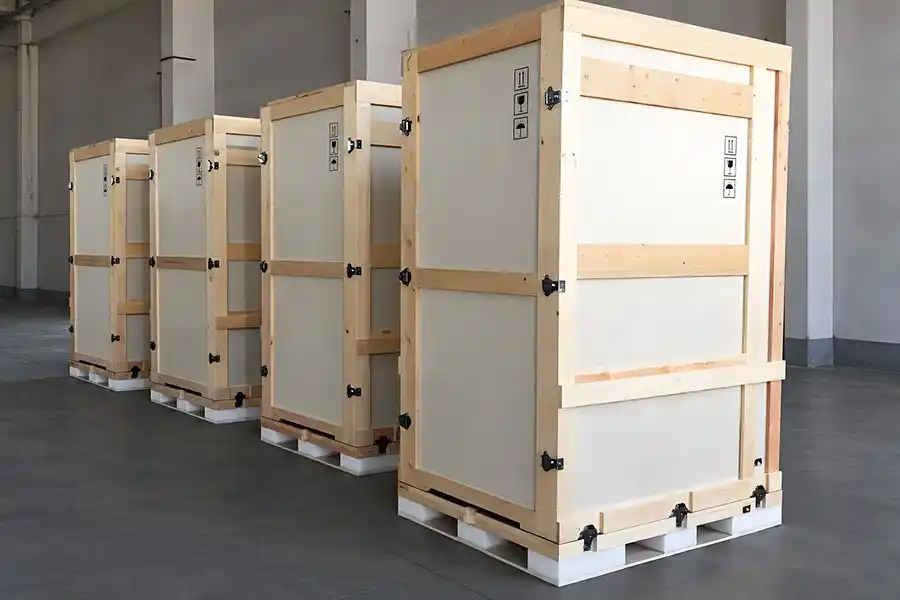
Packaging for pole-mounted transformers typically includes a wooden pallet or crate, metal frames, protective wrapping, and clear shipping marks. The packing list should match the actual units shipped. Shipping dimensions and weights should be recorded for freight planning.
At arrival, the receiving team should record transport damage and check for leaks or damaged bushings.
Warranty terms should be written in the order. A common warranty period for new transformers is 12 months from first energization or 18 months from shipment, whichever comes first. The actual terms depend on the supplier and the contract. Confirm what is covered, what is excluded, and how to file a claim.
About Pole-Mounted Transformer Frequently Asked Questions
Q1: Are Pole-mounted Transformers Safe?
A: Yes—when installed, grounded, and maintained to utility standards. They carry high voltage, so only trained workers should open or service them. Fuses or cutouts, surge arresters, relief valves, grounding, and warning signs reduce risk. Keep away from leaking or damaged units and fallen power lines, and report these to the utility.
Q2: Are Pole-mounted Transformers Filled with Oil?
A: Yes, many pole-mounted distribution transformers are oil filled type. The oil cools the core and winding and provides insulation. Common fluids include mineral oil and less-flammable options such as natural ester. The single-phase and three-phase models covered here are oil-immersed.
Q3: What is the Difference Between a Pole Mounted and a Pad Mounted Transformer?
Pole-mounted transformers sit on utility poles and usually serve overhead distribution lines. Pad-mounted transformers sit on concrete pads at ground level and usually serve underground distribution. Pole units are typically smaller, up to about 167 kVA for single-phase designs. Pad-mounted units can go much larger and often handle three-phase commercial loads. The choice depends on your distribution system and installation space. Click Here, Learn Pad-mounted transformer Details.
Q4: Where are Pole-mounted Transformers Used?
A: Pole-mounted transformers are used on overhead distribution systems. They serve dispersed residential areas, farms, small commercial buildings, and light industrial loads. Utilities use them where three-phase service is not available or not needed. They are common on distribution lines in rural, remote mountainous areas, scattered villages, agricultural production and suburban areas. It can also be used for energy-saving renovations of railway and urban power grids.
Q5: Will a 70% Reduction in No-load Losses Reduce Electricity Bill by 70%?
A: No. A 70% drop in no-load loss does not mean a 70% lower electricity bill. No-load loss is one part of transformer loss. Energized hours determine how long it accumulates. Load losses and the electricity used by the site also affect costs. Compare guaranteed values for the same duty, then calculate the annual energy saved using the project’s operating hours and tariff.
Q6: Can I use the 7.97 kV Catalog Figures for a Transformer Quoted at 13.2 kV?
A: Use a separate approved data sheet for the 13.2 kV design. A shared kVA rating does not establish the same insulation, losses, oil weight or overall size. The 7.97 kV table is a catalog reference for its listed design. Ask for the 13.2 kV unit’s frequency, taps, losses and mounting drawing. Review those values against the project specification before approving production.
Can I Reuse Existing Pole Brackets and a Fuse Cutout When Increasing Capacity?
A: Reuse needs an engineering check against the new unit and the existing protection system. A larger rating can change filled weight, mounting loads, terminal current and fuse coordination. Send the existing bracket drawing, pole data, cutout details and new rating. Ask which items can remain and which need replacement.
Conclusion
Match the pole mounted transformers to the supply, load and site, then agree on price and proof. Compare quotations on the same technical and commercial scope. Use the specification tables as a starting point. Confirm the final drawings, losses, accessories, test records and delivery terms for your order.
Jiangsu Huasheng as a Chinese distribution transformer manufacturers. Huasheng supplies oil-immersed pole-mounted transformers for dispersed residential, rural overhead distribution lines, utility and industrial distribution projects. Send your project requirements to Huasheng.
Related Article:
- Single Phase Transformer Guide: Types, Applications, Sizing – Learn More Single Phase Transformer Total Knowledge and Buying Guide.
- Oil Type Transformer for Distribution Projects: When Choice?
- Top 16 Power Transformer Manufacturers in World
- Padmount Transformer Guide: Types, Sizing, Specifications
- High Voltage Power Transformers Guide: How to Select?