Power Distribution Transformer Solutions
Engineering SupportGlobal Project Supply

Oil-Immersed vs Dry-Type Transformers: What’s the Difference?
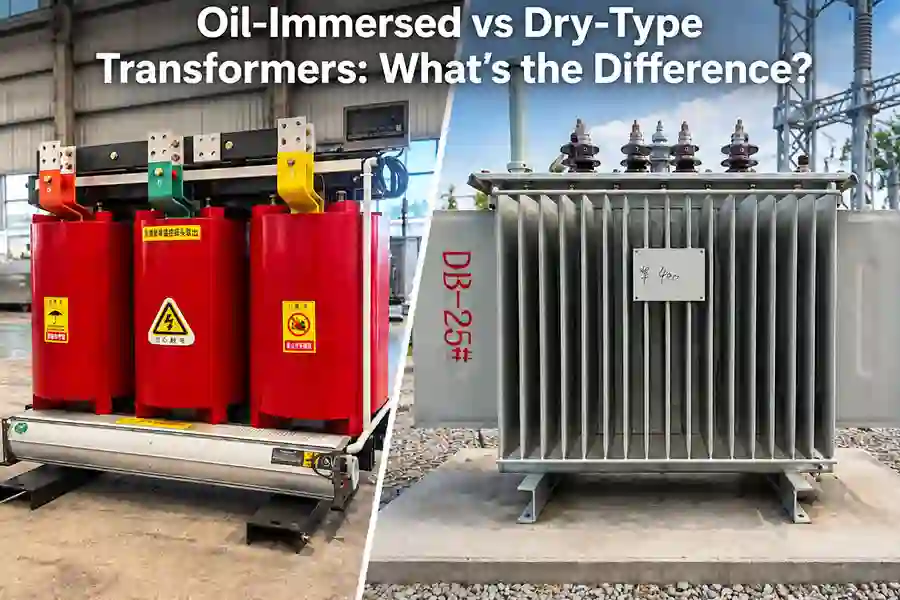
Choosing between a dry-type transformer and an oil-immersed transformer is not simply a choice between two transformer designs.
Both types of transformer can convert voltage and support power distribution. The main differences are in their insulation systems, cooling methods, installation requirements, maintenance, fire considerations, and operating losses.
Dry type transformers use air and solid insulation instead of insulating oil. Oil immersed transformers use insulating liquid for insulation and heat transfer.
For an indoor electrical room, a dry-type transformer is often a starting option. For outdoor utility distribution, an oil-immersed transformer is often a practical choice.
But neither type is automatically right for every project.
The final transformer selection depends on voltage, kVA, load profile, installation environment, cooling, fire requirements, losses, maintenance, and applicable standards.
You can learn more about three-phase transformer selection in related guide: Three-Phase Transformer Guide: Connections, Sizing, and Principles
Key Takeaways
- Dry-type transformers use air and solid insulation instead of transformer oil.
- Oil filled transformers use insulating liquid for insulation and heat transfer.
- Dry-type transformers are often considered for indoor electrical rooms and commercial buildings.
- Oil-immersed transformers are widely used for outdoor utility and industrial distribution.
- Fire safety depends on the complete installation, not only the transformer type.
- No-load loss matters while a transformer remains energized.
- Load loss becomes more important as transformer loading increases.
- Transformer service life depends on temperature, loading, insulation, environment, and maintenance.
- Huasheng supplies both dry-type and oil-type transformers for power distribution and industrial applications.
What Is the Difference Between Dry-Type and Oil-Immersed Transformers?
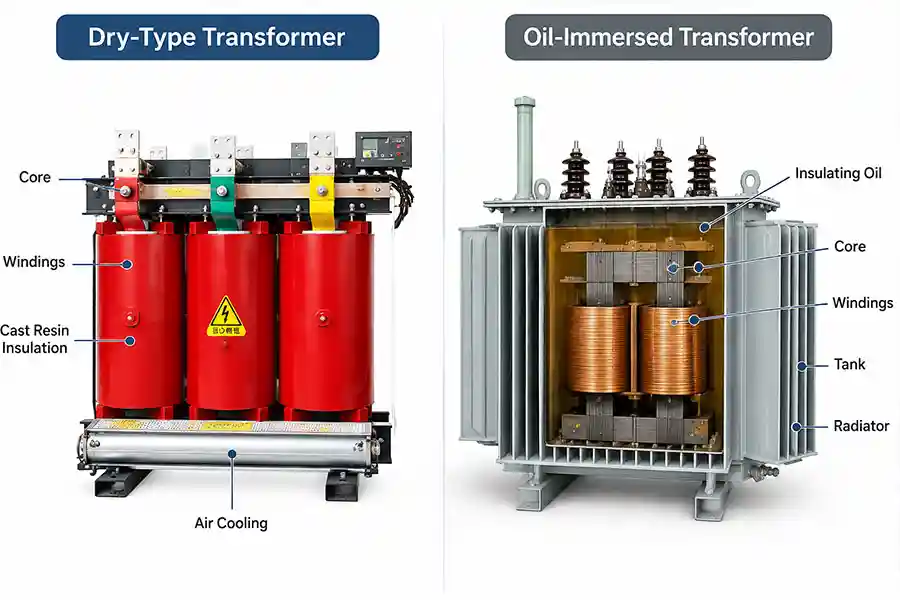
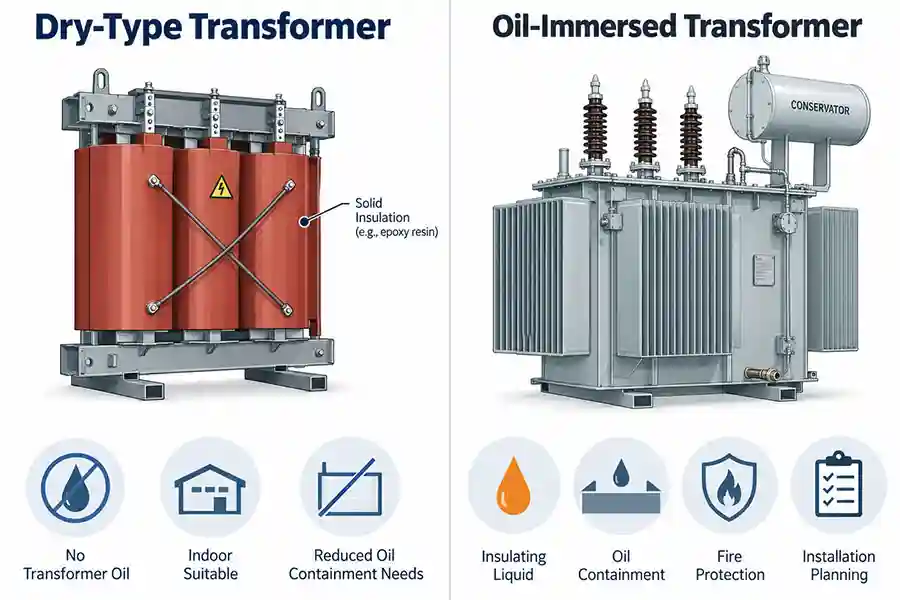
The main difference is the insulation and cooling medium. A dry-type transformer uses air and solid insulation, while an oil-immersed transformer uses insulating liquid around the core and windings.
Both transformer types work through electromagnetic induction. The primary winding receives electrical energy, and the magnetic core transfers energy to the secondary winding at another voltage.
The difference comes from how the transformer manages insulation and heat.
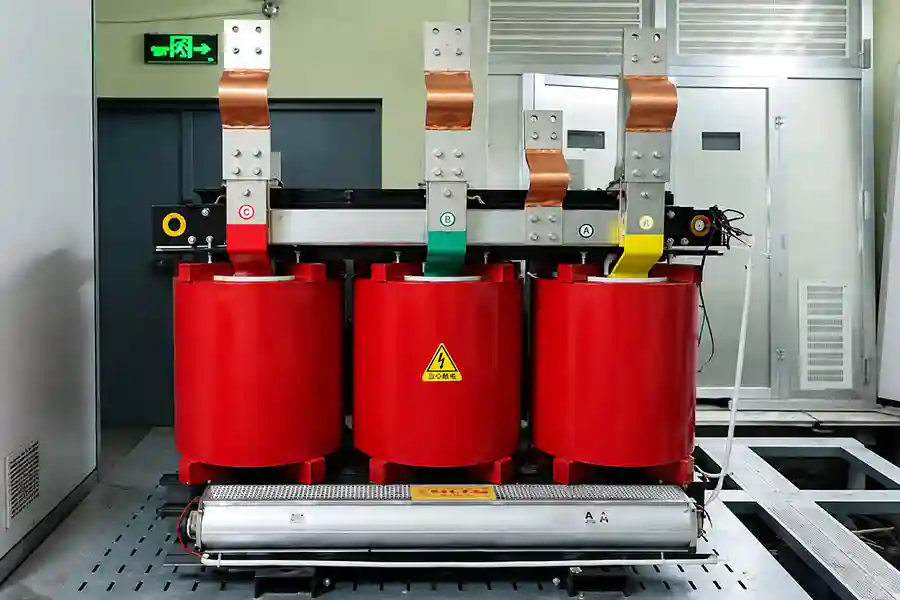
A dry-type transformer does not use insulating oil as its primary cooling and insulation medium. Cast resin designs use solid insulation around the windings, while air removes heat from the transformer.
An oil-immersed transformer places its core and windings inside a tank containing insulating liquid. The liquid provides electrical insulation and transfers heat away from the active parts.
The International Electrotechnical Commission has separate requirements for dry-type transformers and liquid-immersed transformer applications within the IEC 60076 series. IEC 60076-11 specifically covers dry-type power transformers, while IEC 60076-7 covers loading of mineral-oil-immersed transformers.
Dry-Type vs Oil Immersed Transformers: Key Differences
| Factor | Dry-Type Transformer | Oil-Immersed Transformer |
|---|---|---|
| Primary cooling medium | Air | Insulating liquid |
| Primary insulation | Solid insulation and air | Insulating liquid and solid insulation |
| Transformer oil | Not used | Used in oil-filled designs |
| Indoor installation | Common application | Application dependent |
| Outdoor installation | Possible with suitable design | Common application |
| Oil containment | Not required for transformer oil | May be required |
| Ventilation | Important for heat removal | Important for the installation |
| Maintenance | Focuses on insulation, airflow and connections | Also includes liquid, tank and sealing systems |
| Fire considerations | No transformer oil to manage | Liquid and fire protection must be considered |
| Typical applications | Buildings, factories, indoor substations | Utility, industrial and outdoor distribution |
This table provides a general comparison. The actual transformer type should be selected from the project’s technical requirements.
How Do Dry-Type and Oil-Immersed Transformers Work?
Both transformer types transfer electrical energy through electromagnetic induction, but they use different systems to insulate the windings and remove heat.
Every transformer produces heat during operation.
Core losses occur while the transformer is energized. Load losses increase as current flows through the windings.
The insulation system must withstand electrical stress. The cooling system must keep the transformer within its design temperature limits.
This is why transformer selection involves more than voltage and kVA.
How Do Dry-Type Transformers Use Air and Solid Insulation?
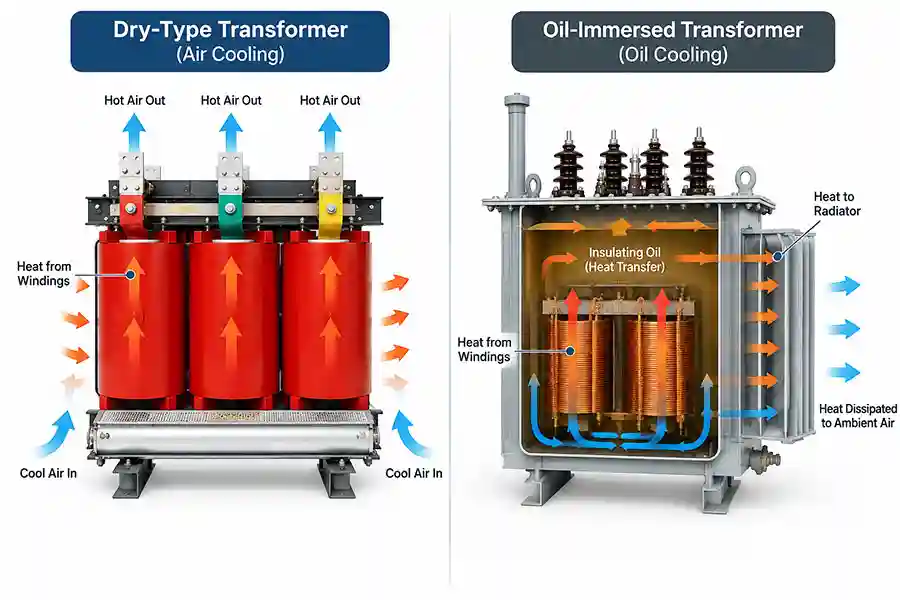
Dry-type transformers use solid insulation around the windings and air as the main cooling medium.
Cast resin transformer designs use epoxy resin to insulate and protect the windings.
The transformer still needs good heat dissipation. Air moves around the active parts and carries heat away from the windings and core.
The installation room therefore affects transformer performance.
The designer should check:
- Room temperature
- Ventilation
- Transformer clearances
- Altitude
- Dust
- Humidity
- Noise
- Capacity
- Temperature rise
- Enclosure requirements
IEC 60076-11 covers dry-type power transformers and includes requirements related to thermal performance, dielectric performance, environmental conditions, altitude, enclosure management, and fire behaviour.
Huasheng manufactures cast resin dry-type transformers using epoxy cast resin insulation and CRGO or amorphous-alloy cores. Its published range covers several medium-voltage systems and distribution capacities.
How Do Oil-Immersed Transformers Use Insulating Liquid?
Oil-immersed transformers use insulating liquid to provide insulation and transfer heat from the core and windings to the tank and cooling surfaces.
Mineral oil is a common insulating liquid for conventional oil-filled transformers.
During operation, heat from the core and windings is transferred to the liquid. The heat then moves to the tank, radiators, or other cooling surfaces.
The liquid is only one part of the insulation system. Solid insulation, winding insulation, oil gaps, clearances, bushings, and other components also control electrical stress.
This is one reason voltage has a direct effect on transformer design.
Higher voltage systems may require different insulation levels, clearances, bushings, winding arrangements, and testing requirements.
Where Are Dry-Type and Oil-Immersed Transformers Commonly Used?
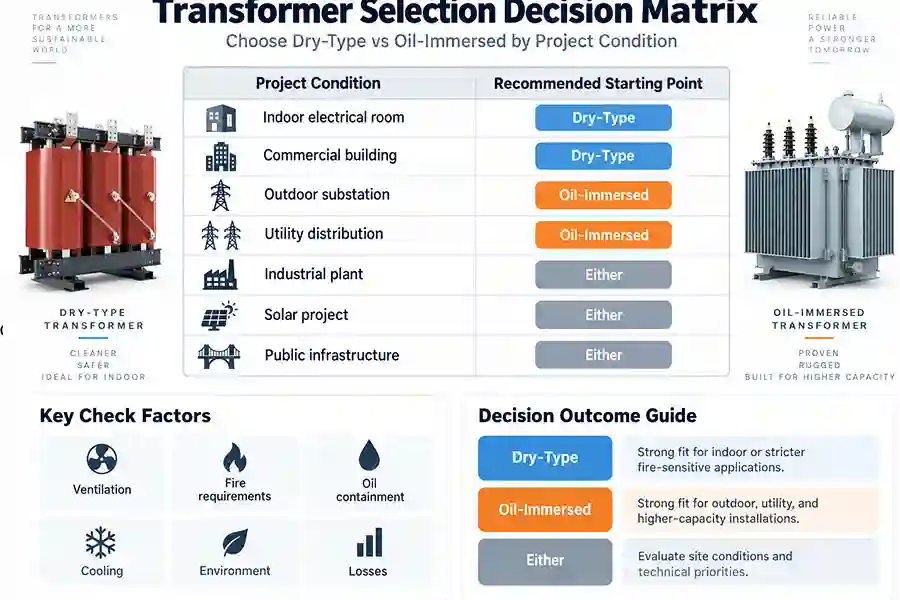
Dry-type transformers are often considered for indoor power distribution. while oil-immersed transformers are widely used for outdoor utility and industrial distribution.
Both types can be used in industrial plants, renewable energy projects, infrastructure projects, and other power systems.
The application alone does not determine the transformer type.
Common Applications
| Application | Starting Point | Main Questions |
|---|---|---|
| Indoor electrical room | Dry-type | Ventilation, temperature, fire requirements |
| Commercial building | Dry-type | Fire safety, noise and available space |
| Outdoor substation | Oil-immersed | Oil containment, cooling and environment |
| Utility distribution | Oil-immersed | Network requirements and installation |
| Industrial plant | Either | Load profile, environment and losses |
| Solar project | Either | Duty cycle, voltage and grid requirements |
| Wind power project | Either | Voltage, loading and site conditions |
| Public infrastructure | Dry-type candidate | Fire strategy and indoor conditions |
These are common starting points, not fixed rules.
Is a Dry-Type Transformer Safer for Indoor Installation?
Dry-type transformers are often the first option to evaluate for indoor electrical rooms when the project limits the use of insulating oil.
This is common in commercial buildings, industrial electrical rooms, public facilities, and other protected locations.
But an oil-immersed transformer is not automatically prohibited indoors.
The final decision depends on:
- Applicable fire rules
- Transformer room design
- Oil containment
- Access
- Ventilation
- Transformer capacity
- Installation environment
- Project specifications
NFPA material for transformer installations includes specific provisions for oil-insulated transformers installed indoors and also addresses dry-type transformer installation requirements. The exact requirements depend on the equipment and installation conditions.
For a dry-type transformer, the designer should still check:
- Room temperature
- Ventilation
- Transformer clearances
- Noise
- Dust
- Humidity
- Capacity
- Temperature rise
- Fire requirements
Huasheng dry-type transformer range includes cast resin units for factories, commercial buildings, public facilities, and indoor substations.
Which Transformer Is Better for Outdoor Installation?
Oil-immersed transformers are often a strong starting option for outdoor utility and industrial distribution when the site can safely accommodate liquid-filled equipment.
Oil-immersed units are widely used for power distribution and outdoor substations because the insulating liquid also provides a practical path for heat transfer.
The site still needs to address:
- Weather exposure
- Oil containment
- Fire protection
- Grounding
- Access
- Corrosion
- Ambient temperature
- Cooling
- Maintenance
A dry-type transformer can also be used outdoors when its enclosure, cooling arrangement, environmental protection, and project design support outdoor operation.
The key question is not simply whether the transformer will be installed indoors or outdoors.
The installation environment must match the complete transformer design.
Huasheng supplies oil-immersed transformers for distribution and power applications across several medium-voltage classes.
Dry-Type vs Oil-Immersed Transformers: Fire Safety
Fire safety is one of the main reasons buyers compare oil-immersed and dry-type transformers.
A dry-type transformer does not contain transformer oil as its primary insulation and cooling medium. This removes the need to manage transformer oil leakage.
An oil-immersed transformer contains insulating liquid. When mineral oil is used, the installation must consider the fire characteristics of the liquid and the protection measures required by local rules.
For outdoor oil-insulated transformers, fire separation and other protection measures may also be required depending on the installation and project design.
This is why fire safety should be treated as a project design issue rather than a simple product label.
For some buildings, dry-type technology may simplify the installation.
For other projects, an oil-immersed transformer may still be practical when the site has the required separation, containment, and protection.
How Does Cooling Affect Transformer Performance?
Cooling affects transformer temperature, loading capability, insulation ageing, and how heat is removed during operation.
Every transformer produces heat.
Some heat comes from core losses. Another part comes from load losses in the windings.
Dry-type transformers use air as the cooling medium. Oil-immersed transformers transfer heat through insulating liquid before releasing it through the tank, radiators, or other cooling equipment.
The cooling arrangement should match:
- Transformer capacity
- Load profile
- Ambient temperature
- Installation environment
- Temperature-rise requirements
- Ventilation
- Altitude
- Cooling equipment
For dry-type transformers, IEC 60076-11 also addresses thermal performance and environmental conditions.
Why Do No-Load Losses Matter?
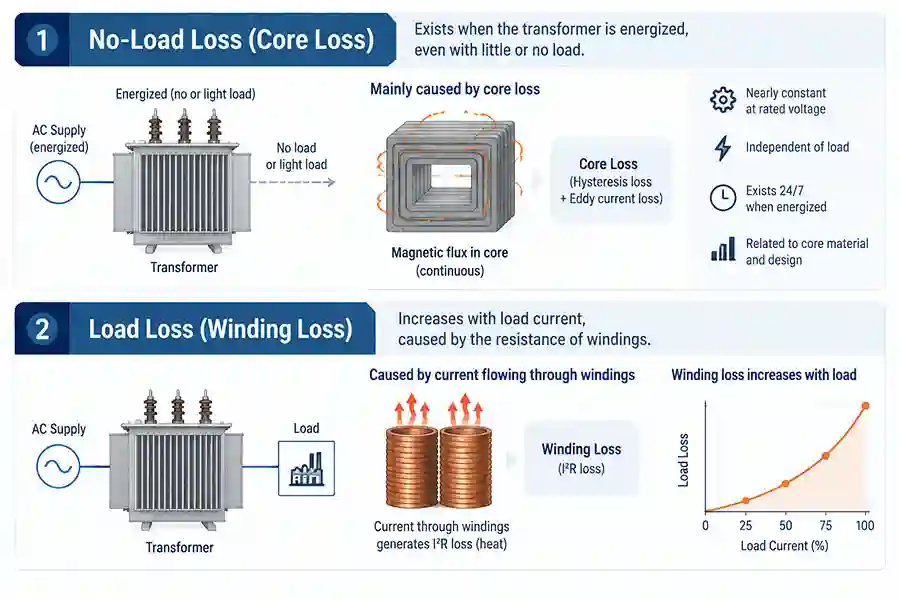
No-load loss matters because a transformer can consume energy whenever it remains energized, even when the connected load is low.
No-load loss is mainly associated with the transformer core.
It occurs when the transformer is energized even if the secondary load is very small.
This matters for transformers that remain connected to the electrical system for long periods.
For example, a distribution transformer may remain energized overnight, during weekends, or during periods of low demand.
Over a long operating period, even a small difference in no-load loss can affect energy consumption.
Core material is one factor that affects no-load loss.
Huasheng offers both CRGO silicon-steel and amorphous-alloy core options for applicable transformer designs. Its published SCBH15 dry-type transformer uses an amorphous-alloy core and is designed for reduced no-load loss.
For transformer selection, compare the guaranteed no-load loss for the exact rating and design.
How Do Load Losses Affect Transformer Operating Cost?
Load loss increases as transformer current increases, so it becomes more important when the transformer operates under higher loading for long periods.
Load loss mainly comes from current flowing through the windings and related current-dependent losses.
The relationship is important because winding losses increase with the square of current.
This means transformer loading has a direct effect on operating loss.
A simple way to view it is:
- Low loading → no-load loss can represent a larger share of total loss.
- Higher loading → load loss becomes more significant.
- Long operating hours → both types of loss accumulate over time.
The U.S. Department of Energy’s transformer efficiency work also distinguishes between no-load losses and load losses when evaluating transformer energy performance.
For this reason, transformer selection should consider the actual load profile rather than only the nameplate kVA.
Compare:
- No-load loss
- Load loss
- Average loading
- Peak loading
- Annual operating hours
- Electricity price
- Expected service period
Which Transformer Has Lower Total Cost of Ownership?
Neither transformer type has a universally lower total cost of ownership.
The purchase price is only one part of the calculation.
A buyer should consider:
- Initial transformer price
- No-load loss
- Load loss
- Annual operating hours
- Electricity price
- Maintenance
- Cooling requirements
- Installation work
- Oil containment
- Fire protection
- Expected service conditions
For example, a transformer that remains energized for most of the year may justify closer attention to no-load loss.
A heavily loaded industrial transformer may require closer analysis of load loss and thermal performance.
A project with strict indoor fire requirements may also place more value on the installation benefits of a dry-type unit.
The right comparison should use actual project data.
What About Transformer Service Life?
Transformer service life depends on temperature, loading, insulation, environment, maintenance, and operating conditions rather than simply on whether the transformer is dry-type or oil-immersed.
Temperature is an important factor.
When a transformer operates at high temperatures for long periods, its insulation system experiences greater thermal stress.
Moisture, contamination, electrical stress, mechanical stress, and repeated loading can also affect ageing.
IEC 60076-7 specifically addresses mineral-oil-immersed transformers and describes how ambient temperature and load conditions affect operating temperature and transformer life.
For dry-type transformers, the same basic engineering principle applies: the insulation system must remain within its specified thermal and electrical limits.
This means service life should not be judged from transformer type alone.
Before ordering, check:
- Temperature rise
- Ambient temperature
- Loading profile
- Insulation system
- Cooling arrangement
- Humidity
- Altitude
- Maintenance requirements
- Applicable standards
What Is the Difference in Maintenance?
Dry-type transformers usually shift maintenance toward insulation, airflow, cleanliness, connections, and enclosure checks, while oil-immersed transformers also require attention to the insulating liquid, tank, seals, bushings, and cooling equipment.
A dry-type transformer has no transformer oil to sample.
However, it is not maintenance-free.
Dust can restrict airflow. Loose connections can create heat. Poor ventilation can raise operating temperature. Moisture and contamination can affect insulation.
Oil transformers have additional liquid-related maintenance requirements.
Depending on the design and project requirements, maintenance may include:
- Oil condition
- Oil level
- Oil leakage
- Tank condition
- Gaskets and seals
- Bushings
- Temperature
- Cooling surfaces
- Connections
- Protection devices
- Insulation condition
The maintenance program should follow the transformer manufacturer’s instructions and project requirements.
The better question is not:
Which transformer needs no maintenance?
The better question is:
What maintenance does this transformer require in this installation environment?
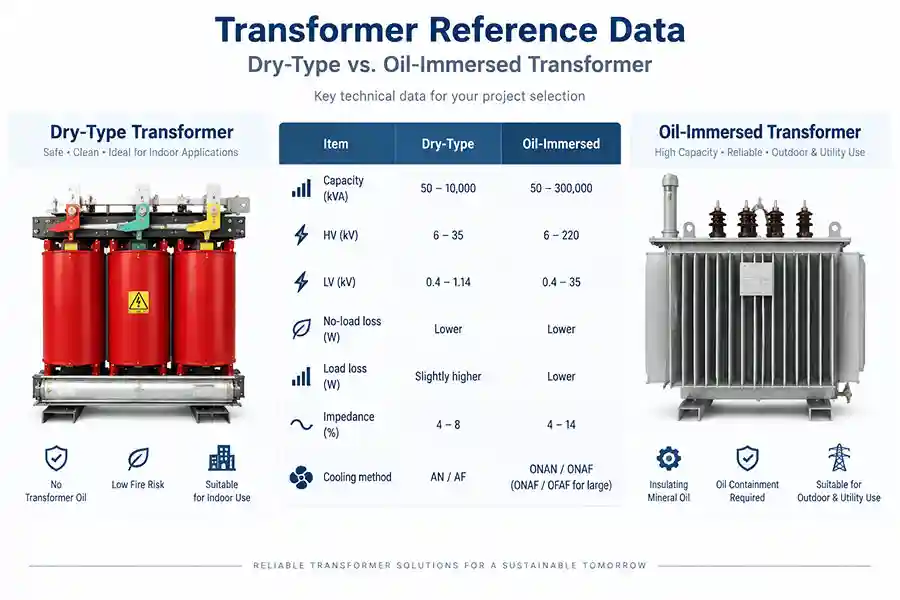
Huasheng Dry-Type vs Oil-Immersed Transformer Reference Data
Huasheng manufactures both dry-type and oil-immersed transformers, so buyers can compare the two technologies against actual transformer configurations rather than relying only on general industry descriptions.
Huasheng published product information shows dry-type transformer designs using cast resin insulation and CRGO or amorphous-alloy cores. Its dry-type range covers 6 kV, 10 kV, 20 kV, 22 kV, 24 kV and 35 kV-class systems, with applicable capacities extending into distribution ratings up to 2,500 kVA.
Published Huasheng Reference Data
| Parameter | Huasheng Dry-Type Range | Huasheng Oil-Immersed Reference |
|---|---|---|
| Transformer type | Dry-type / cast resin | Oil-immersed |
| Phase | Three phase | Three phase |
| Typical 10 kV capacity range | 30–2500 kVA | About 30–2500 kVA |
| Primary voltage | 6, 6.3, 10, 11 kV | 6, 6.3, 10, 10.5, 11 kV |
| Secondary voltage | 0.4 kV | 0.4 kV |
| Insulation | Epoxy cast resin | Liquid + solid insulation |
| Core options | CRGO / amorphous alloy depending on model | CRGO / amorphous alloy |
| Typical cooling | AN / AF depending on design | ONAN for standard distribution designs |
| Oil tank | Not required | Required |
| Example published 1000 kVA data | Final loss values depend on selected model | S11/S13/S20/S22 reference data available |
Huasheng Dry-Type Transformer Reference Range
| Parameter | Huasheng Published Information |
|---|---|
| Main series | SCB and SCBH |
| Typical capacity | 30–2,500 kVA for published 10 kV-class range |
| Primary voltage | 6, 6.3, 10, 11 kV on published 10 kV-class range |
| Other voltage classes | 20, 22, 24 and 35 kV-class designs |
| Insulation | Epoxy cast resin |
| Core options | CRGO silicon steel or amorphous alloy |
| Cooling | AN or AF on applicable designs |
| Phase | Three phase |
The exact capacity, voltage, loss, impedance, vector group, cooling and enclosure should be confirmed against the approved technical specification for the selected model.
Huasheng Oil-Immersed Transformer Reference Range
Huasheng oil-immersed transformer range covers multiple distribution voltage and capacity classes. The final transformer configuration is selected according to the project voltage, capacity, cooling, insulation, loss and installation requirements.
For oil-immersed equipment, Huasheng has also published a detailed 10 kV-class 1000 kVA comparison:
| Series | Core material | No-load loss | Load loss | Impedance |
|---|---|---|---|---|
| S11-M-1000 | Grain-oriented silicon steel | 1,150 W | 10,300 W | 4.5% |
| S13-M-1000 | Improved silicon steel | 830 W | 10,300 W | 4.5% |
| S20-M-1000 | Low-loss silicon steel | 570 W | 10,300 W | 4.5% |
| S22-M-1000 | Premium low-loss silicon steel | 480 W | 10,300 W | 4.5% |
| SH15-M-1000 | Fe-based amorphous alloy | 320 W | 10,300 W | 4.5% |
The final technical values should always come from the approved Huasheng quotation, technical specification and factory test documentation for the selected unit.
Transformer Selection Matrix: Dry-Type or Oil-Immersed?
The best starting point depends on the project condition, because indoor use, outdoor use, load profile, fire requirements, and operating cost can lead to different transformer choices.
Transformer Selection Checklist:
| Selection Factor | What to Check |
|---|---|
| Capacity | Required kVA and future load |
| Voltage | Primary and secondary voltage |
| Frequency | 50 Hz or 60 Hz |
| Phase | Single phase or three phase |
| Load profile | Continuous, peak and variable loads |
| Installation | Indoor or outdoor conditions |
| Cooling | Cooling method and ambient temperature |
| Fire requirements | Applicable local requirements |
| Losses | No-load loss and load loss |
| Insulation | Dry-type or liquid insulation system |
| Oil management | Containment and drainage where applicable |
| Standards | IEC, IEEE/ANSI or project requirements |
| Dimensions | Foundation, access and transport limits |
| Connections | Cable entry, terminals and bus connections |
| Testing | Required factory and third-party tests |
This matrix is a starting point, not a substitute for the electrical design.
Three Transformer Selection Scenarios
The same transformer capacity can lead to different choices when the installation environment and operating conditions change.
Scenario 1: Indoor Commercial Building
A dry-type transformer is often a reasonable starting option when a commercial building needs an indoor transformer and the project limits the use of insulating oil.
Assume the project requires:
- 1,000 kVA
- Indoor installation
- Medium-voltage distribution
- High attention to fire safety
The engineer should then check:
- Required HV and LV voltage
- Ventilation
- Temperature
- Noise
- Available space
- Fire requirements
- No-load loss
- Load loss
A Huasheng cast resin dry-type transformer can be evaluated against these requirements. The final model should be selected from the required voltage, capacity, loss level, impedance, cooling and enclosure.
Scenario 2: Outdoor Industrial Substation
An oil-immersed transformer is often a strong candidate for an outdoor industrial substation when liquid-filled equipment is allowed by the project design.
Assume the project requires:
- 1,000 kVA
- Outdoor installation
- Utility or industrial distribution
- Continuous operation
The buyer should compare:
- Primary voltage
- Secondary voltage
- Load profile
- Cooling
- Oil containment
- Fire separation
- Grounding
- Corrosion protection
- Maintenance access
- No-load and load losses
An oil-immersed transformer may provide a practical cooling arrangement for this type of installation.
But the final choice should still follow the project specification.
Scenario 3: Industrial Plant With High Continuous Loading
An industrial plant with high continuous loading should compare losses, cooling and thermal performance instead of choosing a transformer only by type.
Assume the transformer operates for long hours and carries a high average load.
The buyer should pay close attention to:
- Average load
- Peak load
- No-load loss
- Load loss
- Temperature rise
- Ambient temperature
- Cooling method
- Annual operating hours
- Electricity cost
In this situation, both dry-type and oil-immersed transformers can be considered.
The better choice is the design that meets the electrical, thermal, installation, and operating requirements at an acceptable total cost.
What Information Should You Provide When Selecting a Transformer?
The manufacturer needs the electrical system and installation conditions to select the right transformer, not just the required kVA.
Before requesting a quotation, prepare:
- Required kVA
- Primary voltage
- Secondary voltage
- Frequency
- Number of phases
- Vector group
- Impedance
- Tap range
- No-load loss requirement
- Load loss requirement
- Indoor or outdoor installation
- Ambient temperature
- Altitude
- Load profile
- Cooling requirement
- Fire requirements
- Enclosure requirement
- Applicable standard
- Testing requirements
- Installation dimensions
- Connection requirements
For three-phase power distribution, the transformer connection and system voltage should also be confirmed before selecting a model.
If you are still at the project planning stage, providing the basic electrical data first allows the manufacturer to recommend a suitable transformer type and configuration.
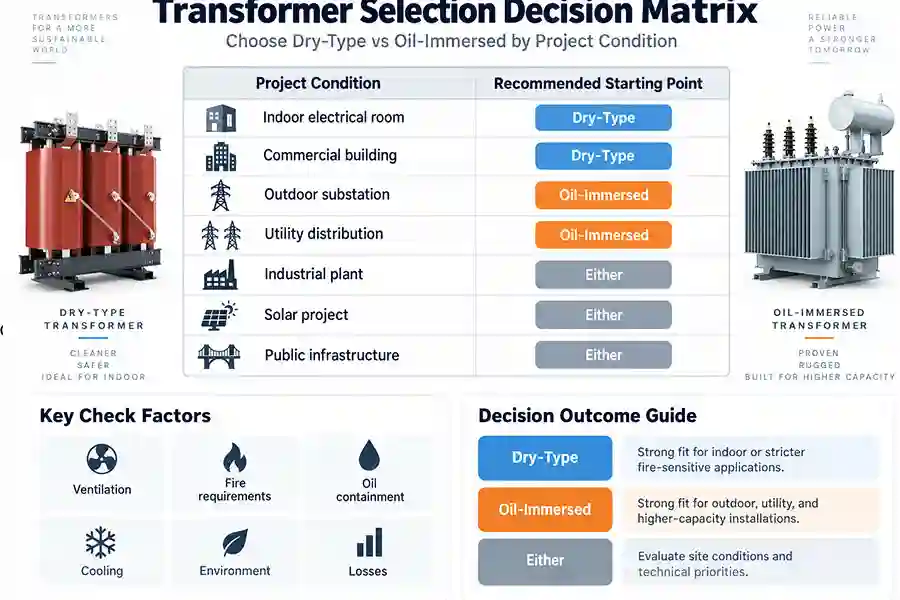
Dry-Type vs Oil-Immersed Transformers: Which One Should You Choose?
Choose a dry-type transformer when the project places strong requirements on oil-free equipment, indoor installation, or certain fire-safety considerations; consider an oil-immersed transformer when liquid-filled equipment fits the outdoor, utility, or industrial distribution design.
Before making the final decision, compare:
- Required voltage
- Required kVA
- Load profile
- Installation environment
- Cooling method
- Fire requirements
- No-load loss
- Load loss
- Maintenance
- Total cost of ownership
- Applicable standards
- Project-specific technical requirements
There is no single transformer type that wins every comparison.
The right transformer is the one that fits the complete project.
Frequently Asked Questions
Is a dry-type transformer better than an oil-immersed transformer?
Neither transformer type is universally better. Dry-type transformers are often considered for indoor electrical rooms, commercial buildings, and applications where transformer oil is undesirable. Oil-immersed transformers are widely used for outdoor utility and industrial distribution. The final choice depends on voltage, kVA, load profile, cooling, fire requirements, installation environment, losses, maintenance, and applicable standards.
Are dry-type transformers suitable for outdoor installation?
Dry-type transformers can be used outdoors when the transformer enclosure, cooling system, environmental protection, and installation design are suitable for outdoor conditions. The designer should consider rain, humidity, dust, ambient temperature, corrosion, ventilation, and protection against environmental exposure. An outdoor installation should therefore be evaluated from the complete transformer design rather than from the dry-type label alone.
Which transformer has lower operating losses?
Neither dry-type nor oil-immersed transformers always have lower operating losses. Losses depend on the transformer design, core material, winding design, capacity, voltage, impedance, and other specifications. Buyers should compare the guaranteed no-load loss and load loss of transformers with the same electrical rating. The actual load profile should also be considered when estimating long-term energy cost.
Which transformer requires more maintenance?
Oil-immersed transformers generally have more liquid-related maintenance tasks because the insulating liquid, tank, seals, bushings, and cooling equipment need inspection. Dry-type transformers do not require transformer-oil sampling, but they still require maintenance. Dust, moisture, poor ventilation, loose connections, and insulation problems can affect dry-type transformer performance.
How does transformer cooling affect selection?
Cooling affects temperature rise, thermal performance, loading capability, and insulation ageing. Dry-type transformers use air as the cooling medium, while oil-immersed transformers use insulating liquid to transfer heat from the active parts. The correct cooling arrangement depends on capacity, loading, ambient temperature, installation conditions, altitude, and transformer design. Ventilation and heat removal should be checked before final installation.
Why should I compare no-load loss and load loss?
No-load loss occurs while the transformer is energized, even when the connected load is low. Load loss changes with transformer current and becomes more significant as loading increases. A transformer that operates continuously may therefore need careful evaluation of both values. Comparing only the purchase price can miss the energy cost that occurs throughout the transformer service period.
How do I choose the right transformer for my project?
Start with the electrical requirements and installation conditions. Confirm the primary and secondary voltage, frequency, phase, required kVA, load profile, indoor or outdoor installation, cooling, losses, fire requirements, applicable standards, and testing requirements. Then compare dry-type and oil-immersed transformers against the same specification. This gives the transformer manufacturer enough information to recommend a suitable configuration.
Conclusion
Dry-type and oil-immersed transformers can both support modern power distribution systems, but they fit different project conditions. Dry-type transformers are often considered for indoor and oil-free applications, while oil-immersed transformers remain widely used for outdoor and utility distribution. The right choice depends on voltage, kVA, load profile, cooling, losses, installation conditions, fire requirements, and project standards.
Huasheng supplies both dry-type and oil-immersed transformers for project-specific power distribution needs.
Technical References Sources
International standards
- IEC 60076-11:2018 — Power Transformers, Part 11: Dry-Type Transformers
- IEC 60076-7:2018 — Loading Guide for Mineral-Oil-Immersed Power Transformers
- IEC 60076-12:2008 — Loading Guide for Dry-Type Power Transformers
- IEC 60076-10:2016 — Determination of Transformer Sound Levels
- IEC 60422 — Mineral Insulating Oils in Electrical Equipment
Government and industry sources
- U.S. Department of Energy — Distribution Transformer Energy Conservation Standards
- OSHA — Transformer Installation Requirements
Related Huasheng Resources
For readers who want to continue from the comparison into transformer selection, these pages provide the next level of information:
- 1000 kVA Oil Filled Transformer: What You Need To Know
- Oil Type Transformer for Distribution Projects: When Is It the Right Choice?
- High Voltage Power Transformers Guide: How to Select?
- Top 16 Power Transformer Manufacturers in World
- How to Choose a Single Phase Pole Mounted Transformer?
- Pole Mounted Transformers Buying Guide: Specs and Costs
- Padmount Transformer Guide: Types, Sizing, Specifications