Power Distribution Transformer Solutions
Engineering SupportGlobal Project Supply

Single Phase Transformer Guide: Types, Applications, Sizing
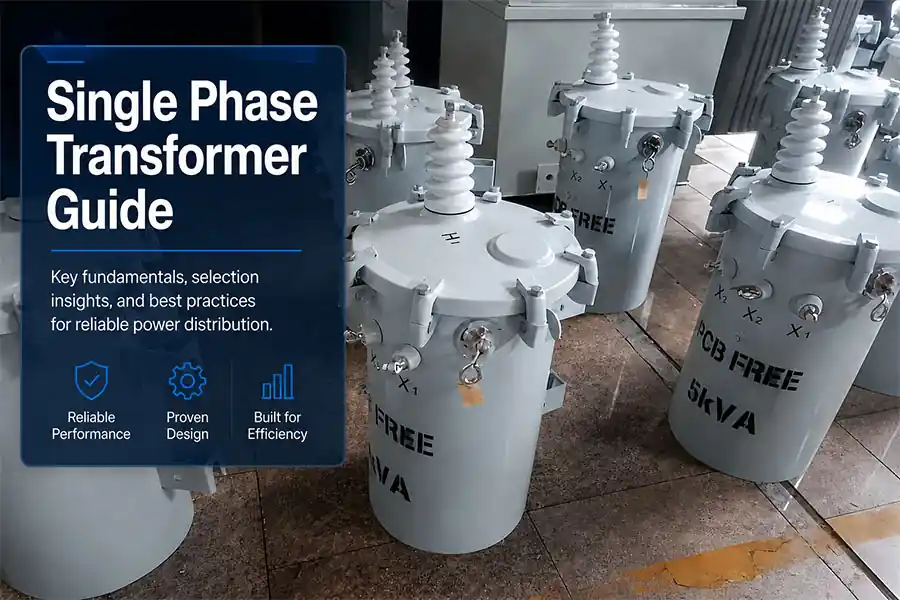
A single phase transformer transfers electrical energy between two single-phase circuits through electromagnetic induction. It can step voltage up or down without changing the supply frequency.
Single-phase transformers serve many types of loads. They are common in homes, rural grids, farms, irrigation systems, and small commercial services.
This guide explains how they work, their main types, how to calculate kVA, and what buyers should include in an RFQ. It also compares single phase pole mounted transformer and pad mounted transformers.
What Is a Single Phase Transformer?
A single-phase transformer changes AC voltage while maintaining a single-phase power supply. It uses a magnetic core and two windings to transfer energy. At the same time, without changing the supply frequency.
Think of it as a translator. It takes the voltage your utility provides. And converts it into something your equipment can actually use. Without changing the language (frequency) itself.
How Does a Single-Phase Transformer Work?
Alternating current enters the primary winding. This current creates changing magnetic flux in the core. The flux then induces voltage in the secondary winding.
The primary and secondary circuits are linked through the magnetic field. They do not need a direct electrical connection. This process is called electromagnetic induction.
Here’s the step-by-step:
- Primary winding connects to the power source and draws alternating current.
- That current generates a continuously changing magnetic field (flux) in the core.
- The secondary winding “sees” that changing flux and—bam—voltage gets induced.
Primary and Secondary Windings
The primary winding connects to the power source. The secondary winding supplies the required voltage to the load.
The turns ratio between these two windings determines the theoretical voltage ratio. Actual output voltage can also change with load, transformer impedance, and voltage regulation.
Step-Up vs Step-Down Operation
A step-up transformer raises voltage. A step-down transformer lowers voltage.
Single-phase distribution transformers often reduce distribution voltage to the level needed by local loads. Like homes, farms, or small commercial loads. Other single-phase transformers may raise voltage for a specific system or item of equipment. (Refer Distribution Transformers Define — U.S. Department of Energy)
A pole-mounted unit sitting on a rural utility pole? That’s typically stepping 7.62kV or 14.4kV down to 120/240V for the house down the road.
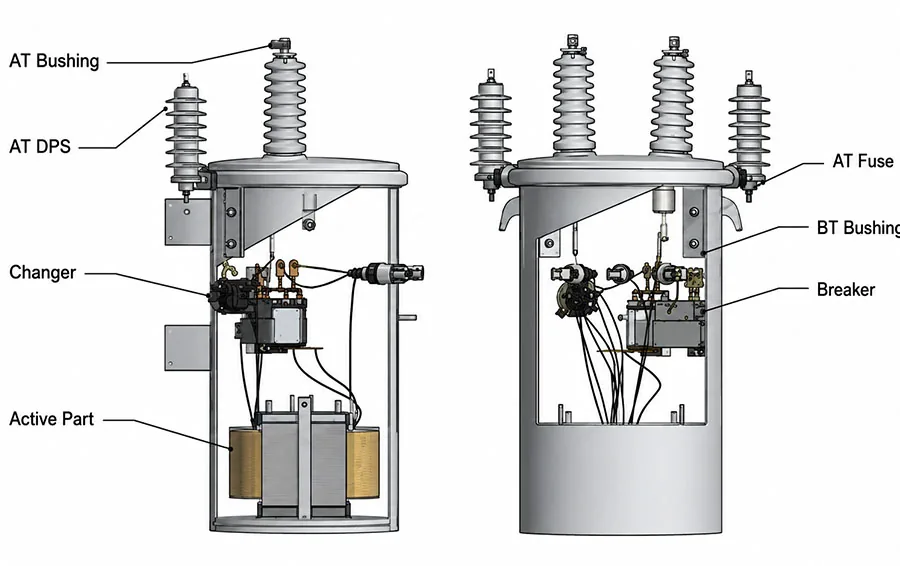
Main Components of a Single Phase Transformers
The main parts of an oil-immersed single-phase transformer include the core, primary and secondary windings, insulating oil, tank, bushings, terminals, and protection parts. Each part supports voltage conversion, insulation, cooling, or safe connection to the grid.
Core and Windings
The core gives magnetic flux a controlled path. It is often made from CRGO electrical steel or amorphous metal.
The windings carry primary and secondary current. Copper and aluminum are both used in transformer windings. The right choice depends on the design, cost, losses, size, and project terms.
Insulating Oil, Tank, and Cooling
Insulating oil provides electrical insulation and carries heat away from the core and windings. The tank holds the oil and protects the active parts.
Tank shape and cooling surfaces vary by design and capacity. Oil level, sealing, and heat flow must suit the expected load and site conditions.
Bushings, Terminals, and Protection Components
Bushings and terminals connect the transformer to the distribution system. While fuses, surge arresters, and grounding components help protect the equipment.
Pole-mounted and pad-mounted units often have different bushing arrangements and protection schemes. The final configuration always comes down to the single-line diagram (SLD), local rules, and technical agreement.
What Types of Single-Phase Transformers Are Available?
Single-phase transformers can be grouped by use, electrical function, and mounting method. Common types include pole-mounted, pad-mounted, isolation, autotransformer, control, toroidal, and instrument transformers.
These names do not all describe the same feature. Pole-mounted and pad-mounted refer to distribution and installation. Isolation and autotransformer describe the electrical function or winding arrangement.
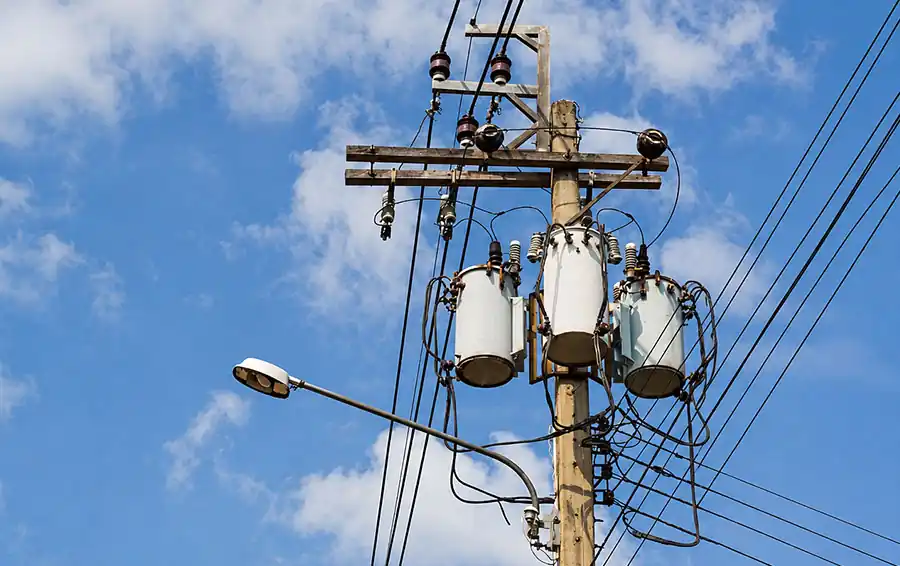
Single-Phase Pole-Mounted Distribution Transformers
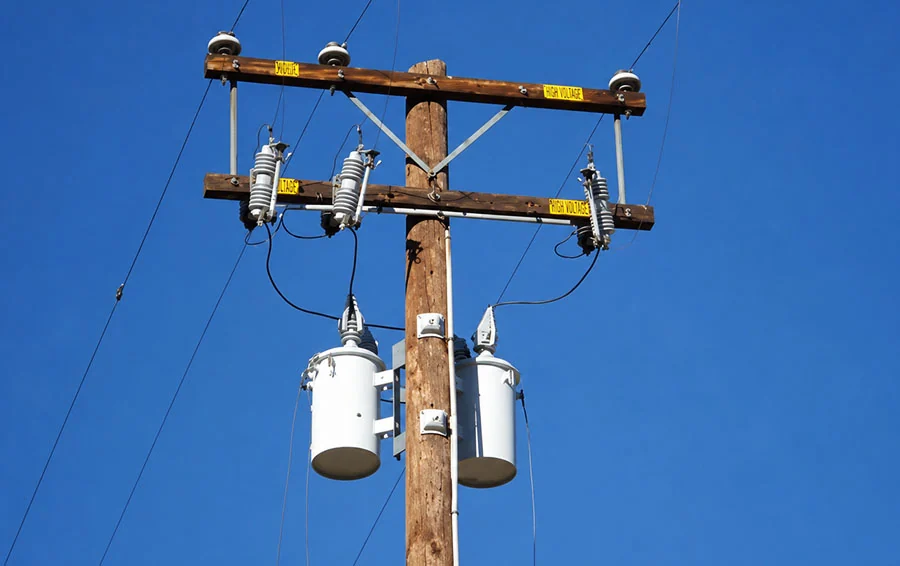
A single-phase pole-mounted transformer is an oil-immersed distribution transformer. It installed on a utility pole. It supplies dispersed loads from an overhead distribution network.
Common uses include rural homes, farms, irrigation pumps, small shops, and residential branches. The unit keeps electrical equipment above ground and close to the overhead line.
Huasheng Transformer offers CON-type single-phase pole-mounted transformers for overhead distribution projects, with catalog configurations covering 5–167kVA.
Typical catalog high-voltage values include 7.62, 7.97, 14.4, and 19.92kV. A common secondary voltage is 120/240V. CRGO and amorphous core options appear in the product range.
These are catalog configurations, not fixed limits for every market. Final voltage, protection, bushing, and loss requirements must be checked for each project.
For U.S.-market projects, overhead-type transformer requirements may refer to the IEEE C57.12.20 series, subject to the specified edition and utility requirements.[
Want to dive deeper? Can Contact Huasheng Transformer Experts for full specifications.
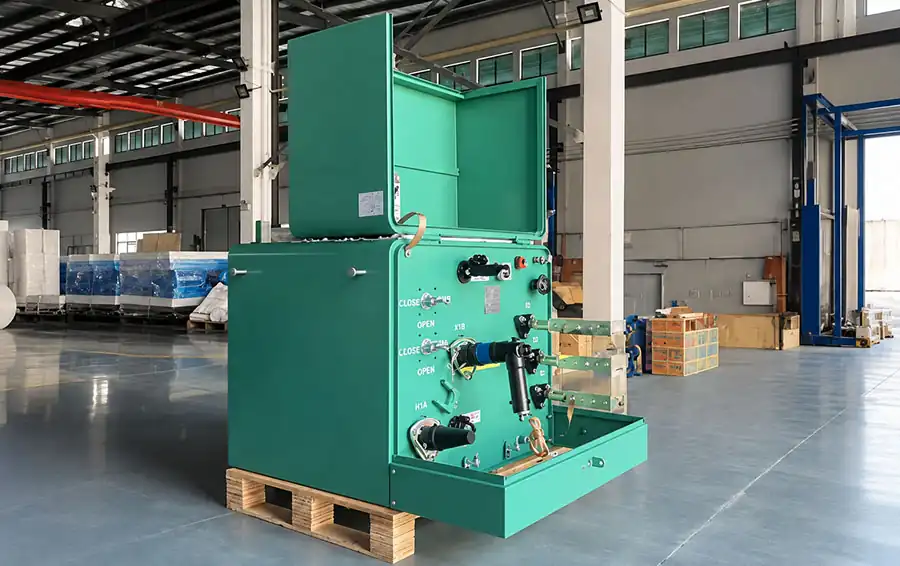
Single Phase Pad Mounted Transformers
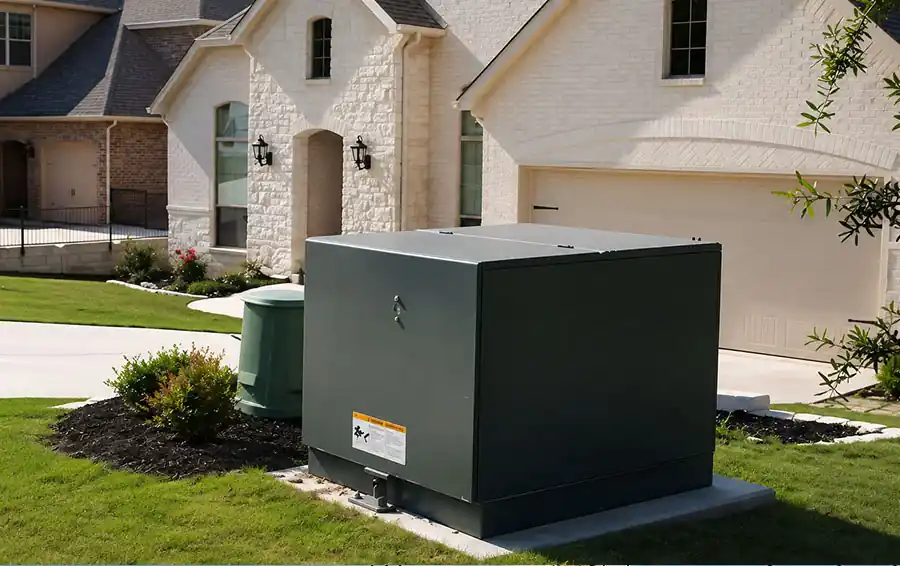
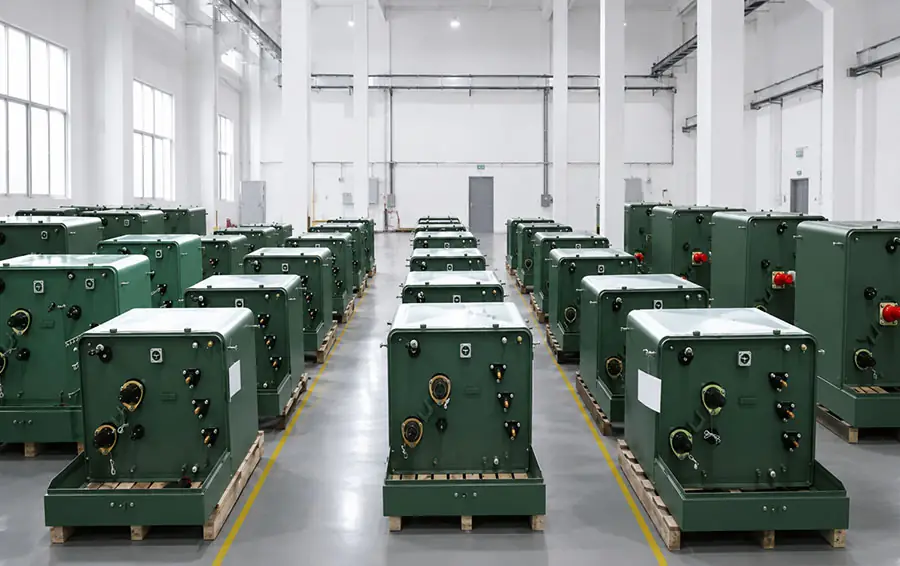
A single-phase pad mounted transformer is an outdoor distribution transformer. It installed on a ground-level pad, commonly as part of an underground distribution system
Primary and secondary cables enter a protected cable compartment. This design is common in residential areas where the distribution cables run below ground.
Huasheng Transformer provides single-phase pad-mounted transformer configurations based on the required voltage, protection scheme, bushings, and applicable project standard.
The company catalog shows typical capacities of about 15–250kVA. Common listed high-voltage values include 7.62 and 19.92kV, with 120/240V on the low-voltage side.
A pad-mounted transformer is not the same as a compact substation. A compact substation can include medium-voltage protection, a transformer, and low-voltage distribution equipment in one system.
Bushing layouts, fuses, cable connections, and market rules vary. Buyers should provide a single-line diagram when possible.
Other Specialized Single-Phase Transformers
Other single-phase transformer types are designed for specialized functions. Such as electrical isolation, voltage adjustment, equipment control, measurement, or protection.
| Type | Main function | Typical application |
|---|---|---|
| Isolation transformer | Separates two circuits | Sensitive equipment and electrical isolation |
| Autotransformer | Uses a shared winding | Voltage adjustment where isolation is not required |
| Control transformer | Supplies control voltage | Control panels, relays, and contactors |
| Toroidal transformer | Uses a ring-shaped core | Compact electronic and low-power equipment |
Read Related Article: Padmount Transformer Buying Guide.
Single Phase Pole Mounted vs Pad-Mounted Transformers
The main difference is the network and mounting method. Pole-mounted transformers normally connect to overhead lines. Pad-mounted transformers sit at ground level and often connect to underground cables.
Capacity alone should not decide the type. The existing grid, cable route, access needs, protection scheme, and local utility rules are more important.
Overhead vs Underground Distribution Networks
A pole-mounted transformer is usually selected for an overhead network. Its primary connection comes from conductors carried by utility poles.
A pad-mounted transformer is usually selected for an underground network. Primary and secondary cables enter at ground level through a cable compartment.
The network type should be confirmed before the buyer compares models or prices.
Installation, Access, and Protection
Pole-mounted transformers need a suitable pole, mounting hardware, clearances, and overhead line protection. Service work takes place above ground level.
Pad-mounted transformers need a stable base, cable routing, working space, and a protected enclosure. The site must also allow safe access for approved workers.
Which Type Fits Your Distribution Project?
Choose a pole-mounted unit for an overhead network. Choose a pad-mounted unit for an underground network. Then confirm voltage, capacity, protection, and local utility rules.
| Factor | Pole-mounted | Pad-mounted |
| Network | Overhead | Underground |
| Installation | Utility pole | Ground-level pad |
| Cable access | Overhead conductors | Cable compartment |
| Common use | Rural and dispersed loads | Residential and underground networks |
| Main site data | Pole and line details | Foundation and cable details |
| Space | Minimal footprint | Requires pad area |
When Should You Use a Single-Phase Transformer?
Use a single-phase transformer when the available supply and main loads are single-phase. It is often a good fit for homes, rural services, farms, small shops, and dispersed distribution loads.
The choice must follow the electrical system. A single-phase transformer should not be selected only because the load seems small.
Suitable Loads and Distribution Systems
Single-phase transformers suit single-phase circuits and smaller or dispersed loads. They are common on rural overhead feeders and in underground residential networks.
The actual capacity range depends on the voltage, load type, utility design, site, and local rules. Single-phase supply + single-phase loads = happy system. Don’t overthink it.
When a Single Phase Transformers Is Not Appropriate
A standard single-phase transformer is not suitable when the main loads need a three-phase supply. Examples include common three-phase motors and larger balanced industrial systems.
The existing power system may also require a three-phase unit.
For a full phase comparison, Pls Read the Article: Three Phase Transformer Guide
Common Applications of Single-Phase Transformers
Single-phase transformers are common where loads are smaller, dispersed, or supplied through a single-phase branch. The mounting style should match the distribution network.
Overhead Utility and Rural Distribution
Pole-mounted single-phase transformers supply dispersed residential, rural, and small commercial loads from overhead utility lines.
Why poles? Because running underground cables across farmland or remote areas gets expensive fast. Overhead lines + pole-mounted transformers = cost-effective distribution.
Underground Residential Distribution
Pad-mounted single-phase transformers are common in residential areas with underground cables. Primary and secondary cables enter the unit at ground level.
The cable layout, protection scheme, enclosure, and utility rules must be confirmed before production. Different markets may use different connection and bushing arrangements.
Think new housing developments. No overhead wires cluttering the view—just a green pad-mounted box tucked away near property lines.
Farms, Irrigation Pumps, and Small Commercial Loads
Single-phase transformers can supply farms, irrigation pumps, workshops, and small shops. But need the supply voltage, load phase, motor starting current are suitable.
Motor loads need extra care. Buyers should provide the motor phase, rated power, starting method, starting current, and duty cycle. Running power alone may not be enough for sizing.
How to Size a Single-Phase Transformer
Size a single-phase transformer by calculating the required kVA. Then check power factor, load type, starting current, duty cycle, site conditions, and future load growth.
A simple kVA result is only the first step. Final selection must also match the network and project rules.
Calculate the Required kVA
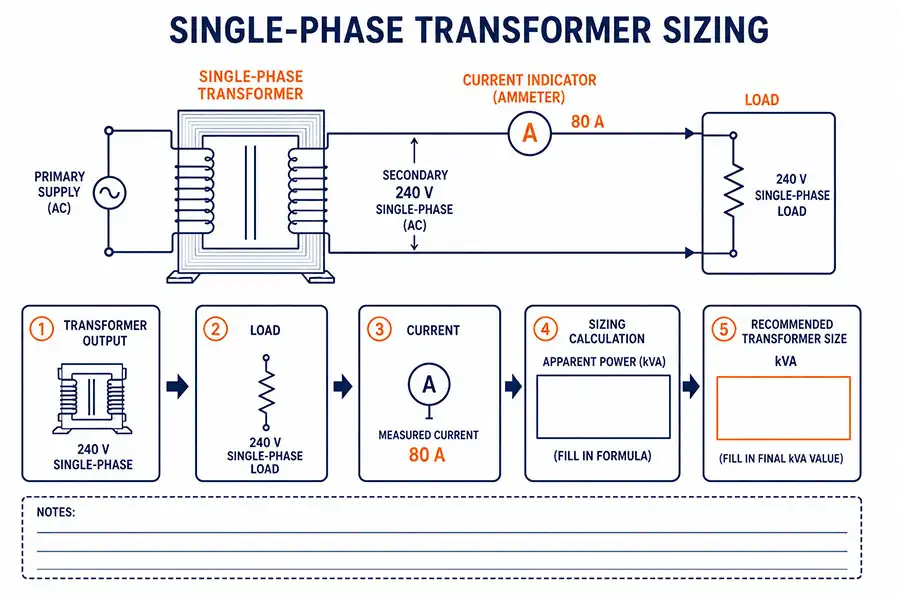
For a single-phase load, calculate apparent power using: kVA = Voltage × Current ÷ 1,000
You can also use: kVA = kW ÷ Power Factor
For example:
a 240V load drawing 80A requires: 240 × 80 ÷ 1,000 = 19.2kVA
A 25kVA rating may be considered, but it should not be selected at once. The buyer must first check starting current, load growth, ambient temperature, altitude, and standard rating steps.
Account for Power Factor and Load Type
Power factor and load type affect the transformer capacity required to supply a given kW load.
A 20kW load at a power factor of 0.8 needs 25kVA. The same 20kW load at a power factor of 1.0 needs 20kVA.
Do not use 0.8 as a fixed rule for every project. Motors, heaters, lighting, electronic loads, and mixed loads behave in different ways.
Consider Motor Starting Current and Duty Cycle
Motors and pumps may draw much more current during starting than during normal operation. So running current alone may not be sufficient for transformer sizing.
A transformer that supplies an irrigation pump may need a different rating from one that supplies a steady lighting load with the same running kW.
You need to know:
- Starting method (direct-on-line, star-delta, soft starter, VFD)
- Starting frequency (how often does it start?)
- Simultaneous starting (do multiple motors start at once?)
- Duty cycle (continuous, intermittent, or cyclic?)
Avoid Under- and Oversizing
An undersized transformer may face high temperature rise, excess voltage drop, and poor service life. May increase project cost. Protection devices may also operate during normal load changes.
An oversized transformer costs more and may run at a low load for long periods.
The right margin depends on motor starting, load changes, future growth, site conditions, and the project specification. A fixed margin should not be applied to every load.
Single-Phase Transformer Losses and Efficiency
Transformer efficiency is affected by no-load loss, load loss, core material, winding design, load level, voltage regulation, and site conditions.
Buyers should compare loss data under the same standard and test basis. A percentage without a stated base may give the wrong picture.
Supporting US Market Distribution Transformer Energy Efficiency Regulatory Background
No-Load and Load Losses
No-load loss mainly occurs in the core whenever the transformer is energized. It remains present even when the secondary load is low.
Load loss increases as current flows through the windings. It includes winding loss and other current-related losses.
Core losses happen 24/7—even when nobody’s using power. Load losses only show up when you’re actually drawing current.
Efficiency and Voltage Regulation
Efficiency is the ratio between useful output power and input power. It changes with the operating load. Voltage regulation describes the change in secondary voltage between no-load and loaded conditions.
Efficiency isn’t a fixed number. It varies with load. And voltage regulation matters because your equipment expects stable voltage—not something that droops when the air conditioner kicks on.
CRGO vs Amorphous Core Options
CRGO is a common transformer core material. It offers stable performance and is widely used in distribution transformers.
Amorphous steel can cut core losses significantly. But the real value depends on your load profile. If your transformer runs lightly loaded most of the time, amorphous might pay off. If it runs near full capacity, CRGO could be the better economic choice.
Temperature Rise and Service Conditions
Ambient temperature, altitude, ventilation, load cycle, and installation conditions can affect temperature rise and allowed loading.
Speak up early. If you’re installing in extreme heat, high altitude, or corrosive environments, mention it in the inquiry phase. Don’t wait until the unit arrives.
Single-Phase Transformer Specification and RFQ Checklist
A complete RFQ should state the electrical ratings, network type, mounting method, site conditions, connection scheme, protection parts, standards, tests, quantity, and destination.
Clear data reduces design changes and price gaps. It also helps the supplier prepare correct drawings and documents.
Capacity and Electrical Ratings
The RFQ should include::
- kVA
- Primary voltage
- Secondary voltage
- Frequency (50Hz or 60Hz)
- Voltage taps (if needed)
- Insulation level (BIL)
- Grounding arrangement
If only kW is known, add the power factor, current, and load details. Motor nameplates and load lists are useful.
Installation and Site Conditions
State whether the network is overhead or underground. Then state whether the transformer will be pole-mounted or pad-mounted.
Tell us:
- Pole or pad installation?
- Ambient temperature range
- Altitude
- Humidity or corrosive conditions
- Space and dimensional constraints
Connections, Bushings, and Protection Accessories
The connection diagram must match the project system.
The buyer should confirm:
- Primary and secondary connections
- Number and position of bushings
- Cable or overhead conductor entry
- Fuse requirements
- Surge arrester requirements
- Grounding parts
- Terminal arrangement
- Other required accessories
Pad-mounted units need special attention to cable entry and compartment configuration. Don’t assume a standard setup works for your market—it often doesn’t.
Applicable Standards and Testing Requirements
The applicable standard depends on the market, utility, and project. The exact standard and edition should be stated in the RFQ. Refere IEC 60076-1:2011 Standard.
Three test levels to know:
- Routine tests – performed on every unit
- Type tests – performed on a representative unit to prove design
- Special tests – additional tests per project requirements
See our transformer quality inspection and testing page for more detail. Compliance claims should match the actual product, report, and certificate scope.
Drawings, Documents, Dimensions, and Delivery Data
Buyers should confirm more details with supplier before approving an order.
- Technical data sheet
- Outline drawing
- Nameplate drawing
- Connection diagram
- Dimensions
- Total weight
- Oil weight
- Packing method
- Quantity
- Delivery destination
- Required delivery date
Transport limits may affect tank size, packing, lifting points, and shipping plans. Buyers should state any port, road, or site restrictions early.
Installation, Inspection, and Maintenance Basics
Safe operation starts with correct installation, nameplate checks, grounding, connection checks, and routine inspection. Qualified workers must carry out installation, testing, and service work. (References to the U.S. Professional Safety Regulation Background)
Pre-Installation Checks
Check the transformer for transport damage, oil leakage, damaged bushings, loose parts, and missing accessories.
Compare the nameplate with the approved drawings and order data. Confirm that the site, support, clearances, cables, and grounding are ready before installation.
Never skip this step. A damaged unit installed without inspection becomes a very expensive problem.
Routine Inspection Items
Routine checks may include oil leakage, bushings, terminals, grounding, temperature, loading, noise, and visible damage.
Maintenance schedules vary by project and equipment type. Follow the documentation—don’t guess.
Common Problems and When to Contact the Supplier
Overheating, unusual noise, oil leakage, damaged bushings, protection operation, or unexpected voltage change needs review by qualified staff.
Do not open the tank or work on energized equipment without an approved safety process. Send the supplier the nameplate photo, load data, test readings, and fault details.
Frequently Asked Questions
These short answers cover common technical and buying questions about single-phase distribution transformers.
What Does 120/240V Mean on a Single-Phase Transformer?
A 120/240V secondary often provides 240V across the full winding and 120V between either end and the center tap.
The exact terminal layout and load connection must match the approved connection diagram.
Can a Single-Phase Transformer Supply a Three-Phase Load?
A standard single-phase transformer cannot directly provide a full three-phase supply for a common three-phase load.
The power source, load, phase arrangement, and system design must be reviewed.
Can a Single-Phase Transformer Be Installed Outdoors?
Yes. if the tank, bushings, enclosure, insulation, protection parts, and finish are designed for the stated outdoor conditions.
Pole-mounted and pad-mounted units are outdoor distribution forms. The final design must match the site and local rules.
Conclusion
A single phase transformers aren’t complicated. But getting the specification wrong? That’s where the headaches start. Then decide whether the network needs a pole-mounted or pad-mounted transformer. Finally, confirm the voltage, kVA, protection, standards, site conditions, and documents.
Huasheng is a professional distribution transformer suppliers, You can send problems to us.
Read Related Article:
If Have Project Questions, Contact Huasheng Experts: