Power Distribution Transformer Solutions
Engineering SupportGlobal Project Supply

1000 kVA Oil Filled Transformer: What You Need To Know
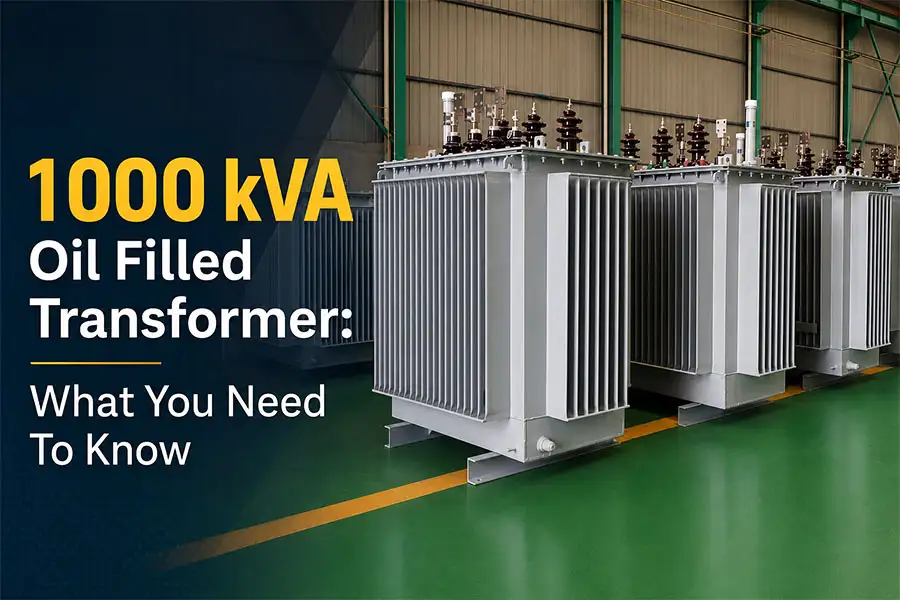
A 1000 kVA oil filled transformer can supply a large factory, pump station, commercial building or utility distribution point. But 1000 kVA alone does not tell me if the transformer will work for a project.
I first check the load, voltage, frequency and local utility rules. Then review losses, winding material, oil, cooling, temperature, altitude, packing and delivery. A 10 kV transformer for a humid coastal site is not the same product as a 35 kV unit for a high-altitude mine.
Huasheng as a China oil filled transformer manufacturers. This article explains what a 1000 kVA oil filled transformer is, how much load it can supply, how the main 10 kV models compare, what the price may be and what I ask before preparing a quotation.
Read Related Article: Oil Type Transformer for Distribution Projects, When to Choose?
What is a 1000 kVA Oil Filled Transformer?
A 1000 kVA oil filled transformer is a liquid-insulated transformer. Rated to transfer 1000 kVA of apparent power between a medium-voltage network and a lower-voltage system.
The core and windings are placed in insulating liquid. The liquid provides electrical insulation and carries heat to the tank and radiators. In a normal distribution project, the transformer steps medium voltage down to 400 V, 415 V, 433 V or another low-voltage value.
The terms “oil filled transformer” and “oil immersed transformer” usually refer to the same basic product family. “Oil filled” is common in buying searches. “Oil immersed” appears often in technical documents and standards. The buyer should confirm the liquid type, cooling code, voltage ratio and governing standard.
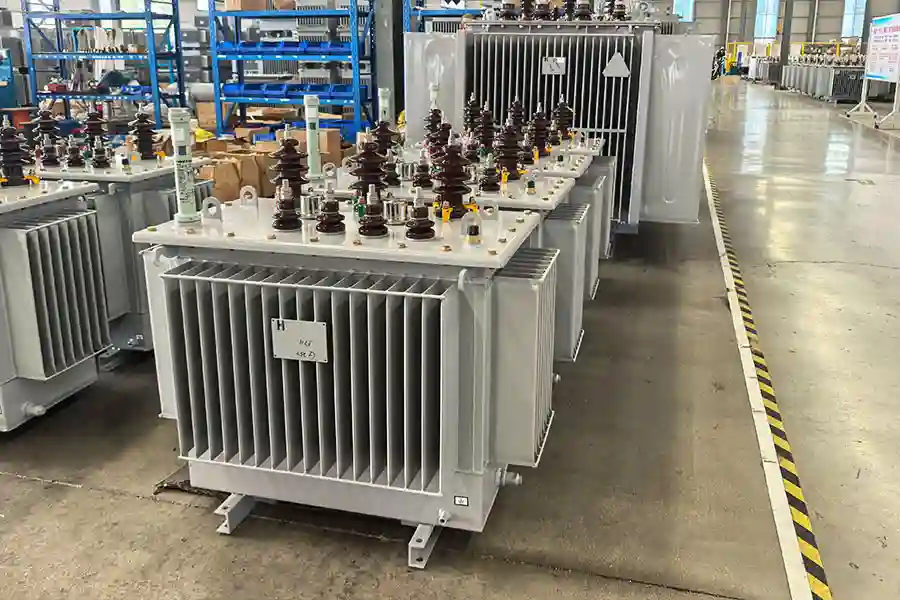
What Are the Specifications of a 1000 kVA Oil Immersed Transformer?
A common starting configuration is a three-phase, 10 kV/0.4 kV, Dyn11, ONAN transformer with a hermetically sealed tank.
| Parameter | Typical configuration |
|---|---|
| Rated capacity | 1000 kVA |
| Phase | Three phase |
| Primary voltage | 10kV class (also 6 kV, 6.3 kV, 11 kV, 20kv, 35kV available) |
| Secondary voltage | 0.4 kV (400 V) |
| Frequency | 50 Hz or 60 Hz |
| Cooling | ONAN |
| Vector group | Dyn11 or Yyn0, project-specific |
| Impedance | Often around 4.5%, project-specific |
| Tap range | ±5% or ±2 × 2.5% |
| Winding | Copper or aluminum |
| Insulating liquid | Mineral oil; ester fluid available on request |
| Tank | Hermetically sealed corrugated tank |
| Installation | outdoor, according to design |
Final voltage ratio depends on the local utility and project specification. This table is a planning reference. It does not replace the approved data sheet or factory test report.
Send your voltage, frequency and destination country to receive the matching technical specification.
What electrical data should appear on the nameplate?
The nameplate should show the values needed to operate, protect and identify the transformer.
It normally lists capacity, voltage ratio, frequency, phase, vector group, impedance, cooling code, oil mass, serial number and applicable standard.
The drawing should also show the bushing position, neutral connection, earthing points and cable-entry direction. These details affect the foundation and site work.
How Do the 10 kV 1000 kVA Models Compare?
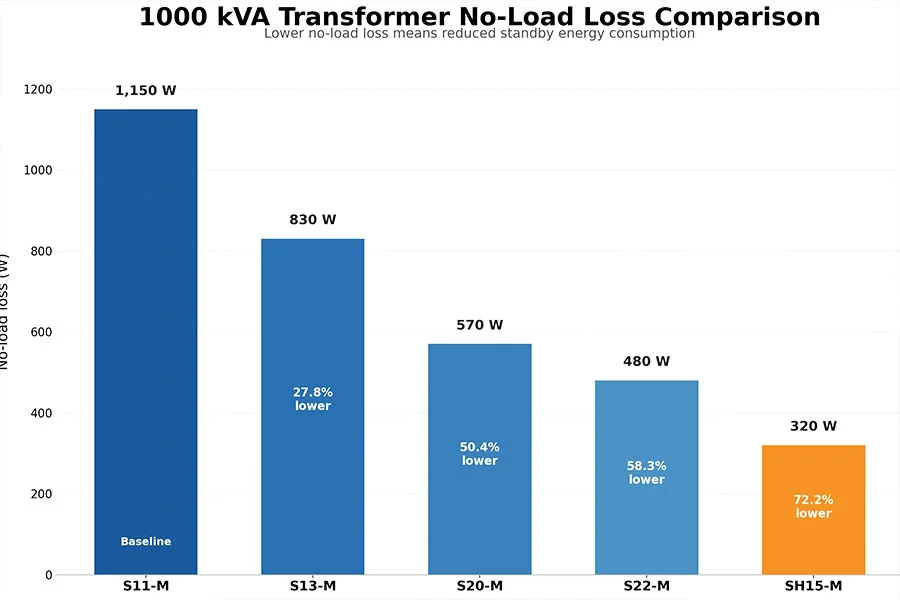
This is where things get interesting. The five main series — S11, S13, S20, S22, and SH15 — all have different no-load losses. Here’s the comparison for 10 kV-class, three-phase, hermetically sealed units:
| Series | Core material | No-load loss | Reduction vs S11 | Load loss | No-load current | Impedance |
| S11-M-1000 | Grain-oriented silicon steel | 1,150 W | – | 10,300 W | 1.0% | 4.5% |
| S13-M-1000 | Improved silicon steel | 830 W | 27.8% lower | 10,300 W | 0.6% | 4.5% |
| S20-M-1000 | Low-loss silicon steel | 570 W | 50.4% lower | 10,300 W | 0.6% | 4.5% |
| S22-M-1000 | Premium low-loss silicon steel | 480 W | 58.3% lower | 10,300 W | 0.6% | 4.5% |
| SH15-M-1000 | Fe-based amorphous alloy | 320 W | 72.2% lower | 10,300 W | 0.3% | 4.5% |
A few things to notice here. The load loss stays the same across all five series at 10,300 W. The difference is all in the no-load loss — and that matters a lot if your transformer runs 24/7.
Also, these are reference values. The final guaranteed numbers depend on the approved technical specification, applicable standard, and factory test report. Don’t treat this table as a fixed datasheet.
The engineering team can compare the available series after reviewing your project load, operating hours, electricity tariff, and loss requirements. That’s the right way to choose — not just picking a model number off a list.
The reduction percentages use S11-M-1000 as the baseline:
(S11 no-load loss − selected model loss) ÷ S11 no-load loss × 100%
What do S11-M, S13-M, S20-M, S22-M and SH15-M mean?
These model names mainly indicate Chinese efficiency series and core technology; overseas buyers should confirm the electrical values instead of choosing by the code alone.
The letters and numbers help identify the design family. They do not replace voltage, loss, impedance, insulation level or test requirements in an international purchase order.
What is the S11-M-1000 transformer?
S11-M is a standard low-loss silicon-steel distribution transformer series.
It is often used where the project needs a proven design with a moderate purchase price. The “M” commonly refers to a sealed tank design in this product family. The 1000 kVA version in the reference table has a 1,150 W no-load loss and a 10,300 W load loss.
This series can fit factories, workshops and utility distribution points where the transformer is energized for long periods but the budget does not support a higher-efficiency core.
How Does the S13-M-1000 Reduce No-Load Loss?
S13 improves on S11 with better core and coil design. The no-load loss drops to 830 W — about 28% lower than S11. It’s a good middle-ground option for distribution and industrial projects. If you’re comparing initial price against long-term electricity cost, S13 often makes sense.
What is the S20-M-1000 Energy-Efficiency Level?
S20 uses lower-loss silicon steel and brings the no-load loss down to 570 W. That’s significantly better than S11 and S13. It’s worth considering if your transformer stays energized for long hours or if electricity is expensive in your region. But remember — low no-load loss doesn’t mean all losses are low.
Why is the S22-M-1000 a Premium Silicon-Steel Option?
S22-M targets a lower no-load loss than S20-M by using a higher-grade silicon-steel core and tighter manufacturing control.
The reference no-load loss is 480 W. The difference may look small on a quotation sheet, but it continues every hour that the transformer remains energized.
For a project with high annual operating hours, the buyer should compare the extra purchase cost with the expected energy saving. A simple payback check is more useful than selecting a series only because its number is higher.
Why does the SH15-M-1000 use An Amorphous Alloy Core?
SH15 uses an iron-based amorphous alloy core. The reference no-load loss is just 320 W, and the no-load current is around 0.3%. Amorphous alloy can reduce no-load losses by 70–80% compared to conventional silicon steel cores.
But here’s the catch — amorphous alloy mainly reduces no-load loss. The actual load loss depends on the complete transformer design. Also, amorphous cores are more sensitive to mechanical stress and assembly quality. They work best for applications with long operating hours, low average loads, or fluctuating loads — like rural grids or certain industrial settings.
What is the Difference Between Copper and Aluminum Windings?
Copper has higher conductivity and needs less conductor space; aluminum usually reduces weight and first cost.
| Item | Copper winding | Aluminum winding |
| Conductivity | Higher | Lower |
| Conductor size | More compact | Larger |
| Weight | Heavier | Lighter |
| Initial cost | Higher | Lower |
| Common use | Compact or high-performance designs | Cost-sensitive distribution projects |
Copper is not automatically the right choice. The decision depends on current, available space, temperature rise, budget, project standard, transport limits and expected service conditions.
The quotation should state the winding material. It should also state whether the loss guarantee applies to the selected material and the agreed test temperature.
What Type of Insulating Liquid is Used?
Mineral insulating oil is the normal configuration for many 1000 kVA distribution transformers. Ester fluids can be supplied when the project requests them.
Options include:
- Mineral insulating oil
- Natural ester fluid
- Synthetic ester fluid
The choice affects flash point, environmental handling, material compatibility, oil filling, testing and price. If ester fluid is not part of the confirmed design, it should be described as “available upon project request.”
The factory should provide oil test data, filling records and safety information required by the destination market. From IEEE dissolved gas analysis guide.
What Does Hermetically Sealed Mean?
A hermetically sealed transformer keeps the insulating liquid and active parts separated from outside air.
A corrugated tank allows controlled expansion and contraction as the oil temperature changes. This reduces direct contact with moisture and oxygen.
How does a hermetically sealed tank work?
The tank wall changes shape slightly as the liquid heats and cools.
When the transformer heats up, the corrugated wall expands. When it cools, the wall contracts. Welding quality, gasket material, pressure control and oil filling level must all be checked.
The tank still needs the pressure-relief device, thermometer and other accessories required by the project.
What Are the Benefits?
- Compact footprint — no conservator tank sticking up
- Lower maintenance compared to conservator-type units
- Good for outdoor distribution
- Works well in humid and coastal environments
- Reduced oil degradation from air exposure
Does hermetically sealed mean maintenance-free?
No. A sealed transformer still needs regular inspection and electrical testing.
Operators should check for oil leaks, unusual sound, high temperature, bushing damage, loose cable connections and corrosion. Pressure and temperature alarms should also be tested.
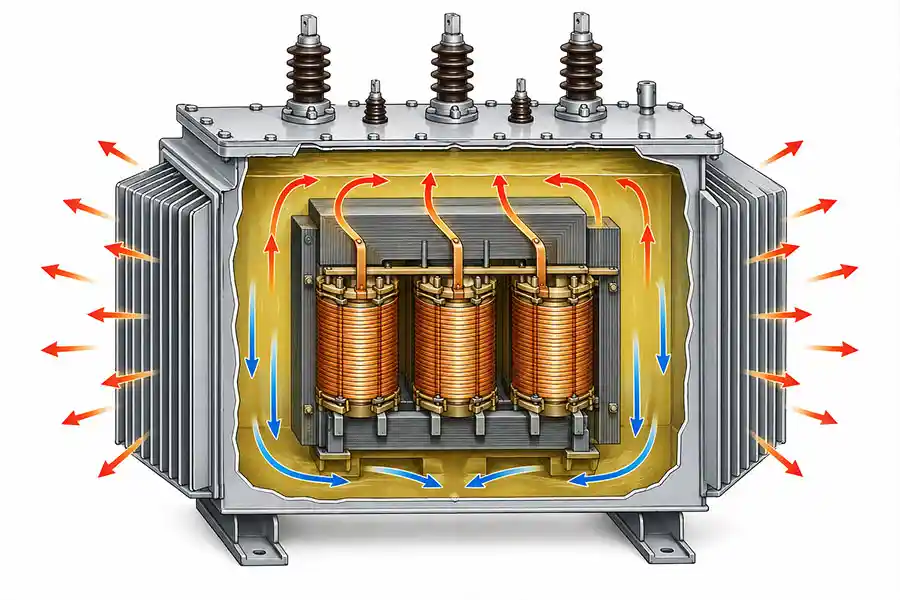
Is ONAN Cooling Suitable for a 1000 kVA Transformer?
ONAN is suitable for many industrial, commercial and outdoor distribution projects when the ambient temperature and load profile remain within the design limits.
Oil circulates naturally inside the tank. Air removes heat without pumps or fans. This keeps the cooling system simple and reduces auxiliary power.
A different design may be needed for:
- Ambient temperature above the normal design value
- Long periods near full load
- Short-time overload requirements
- High altitude
- Limited ventilation
- Heavy harmonic current
The factory may recommend larger radiators, a derated rating, a higher-ambient design or ONAF cooling with fans.
Are 1000 kVA Transformers Available for 10 kV, 20 kV and 35 kV Systems?
Yes. A 1000 kVA oil filled transformer can be designed for 10 kV, 20 kV, or 35 kV systems. But the insulation system and technical parameters change with the voltage class.
What Is the 10 kV 1000 kVA Configuration?
The five-model comparison above is for 10 kV-class units — three-phase, hermetically sealed, with 0.4 kV on the low-voltage side. That’s the most common configuration for industrial and commercial distribution.
Can a 20 kV 1000 kVA Transformer Be Supplied?
Yes. 20 kV oil-immersed distribution transformers are available from around 30 kVA up to 2,500 kVA, so 1000 kVA fits right in. But you can’t just take the 10 kV table and apply it to 20 kV. The insulation level, bushings, creepage distance, impedance, and losses all need to be re-confirmed for the higher voltage.
For example, a 20 kV unit might have different no-load and load loss values compared to the 10 kV version.
Can a 35 kV 1000 kVA Transformer Be Supplied?
Yes, but a 35 kV oil-immersed transformers project usually needs higher insulation levels and closer coordination with the utility protection system.. A 35 kV design may use different low-voltage combinations. The specific model, losses, dimensions, weight, and applicable standard all need separate confirmation.
Don’t submit a model number and assume it works. Submit your voltage class, HV/LV ratio, frequency, installation location, and applicable standard. Let the factory figure out the right configuration.
How Much Load Can a 1000 kVA Transformer Supply?
The usable output depends on power factor, load shape, temperature, altitude and the operating reserve required by the project.
At 0.8 power factor, the real-power figure is about 800 kW. A plant with large motors, welding machines or variable-speed drives may need more capacity than a simple kW total suggests.
Before confirming the rating, the factory needs:
- Present maximum demand
- Motor ratings and starting method
- Power factor
- Welding or rectifier loads
- Harmonic-producing equipment
- Daily operating hours
- Seasonal demand
- Three-to-five-year expansion plan
- Existing generator, solar or grid connection
A transformer should not operate at its thermal limit every day. A reasonable reserve can reduce trips and leave room for growth. A much larger unit, however, adds cost and fixed no-load loss.
How Much Does a 1000 kVA Oil Filled Transformer Cost?
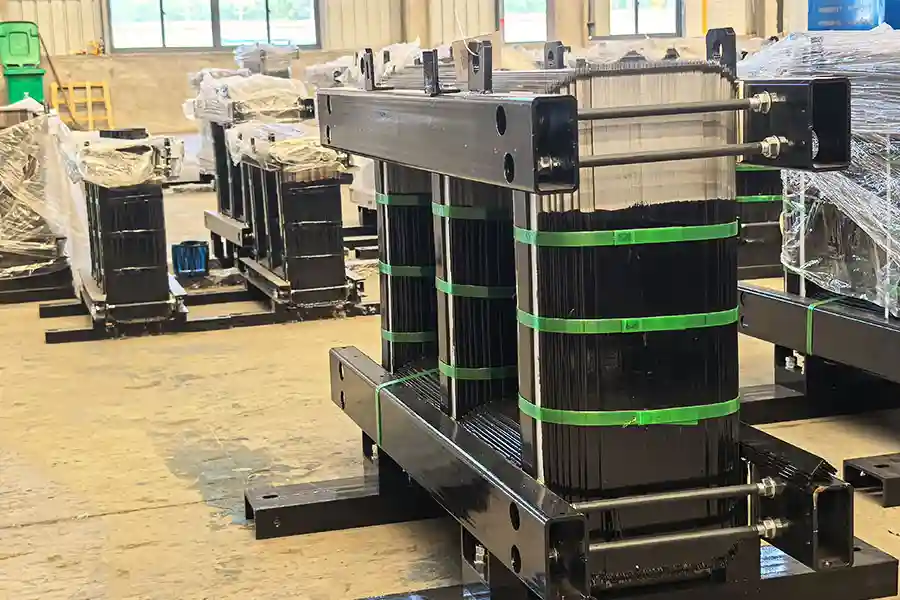
A standard 10 kV-class, 1000 kVA, three-phase hermetically sealed oil-filled transformer has an indicative ex-factory price of about US$9,000–US$9,600.
Industry sources confirm a broader range of US$8,000–US$25,000 for standard configurations, with customized high-spec units going above US$25,000. In the Chinese domestic market, a 10 kV S13 copper-winding 1000 kVA unit typically runs between RMB 80,000 and RMB 130,000.
Huasheng Transformer uses this range only as a reference for a standard 10 kV-class configuration. It is not a fixed quotation for every project.
What’s Included in the US$9,000–US$9,600 Reference Price?
This covers:
- 10 kV-class
- 1000 kVA
- Three-phase
- Hermetically sealed tank
- Standard distribution configuration
- Standard factory testing
- Standard packing (if applicable)
It does NOT cover 20 kV or 35 kV. It’s not a landed cost. Prices fluctuate with copper, silicon steel, oil, and exchange rates.
What Factors Change the Final Price?
- Core material (S11/S13/S20/S22 vs amorphous alloy)
- Copper vs aluminum windings (copper adds 20–30% or more)
- Voltage class and insulation level
- Tank structure and accessories
- Tap changer type
- Mineral oil vs ester fluid
- Factory testing and third-party inspection
- Export packing and certification
- Delivery terms (EXW, FOB, CIF)
Which Standards and Tests Apply to a 1000 kVA Oil Filled Transformer?
The applicable standard depends on the country, utility, voltage class, efficiency requirement, and project specification.
Which Chinese Standards Apply?
- GB/T 1094 series (power transformers)
- GB/T 6451 (oil-immersed power transformers)
- GB 20052-2024 — this is the latest energy efficiency standard for power transformers, effective February 1, 2025. It covers 10 kV, 35 kV, and other voltage classes (Reference: GB 20052 transformer efficiency requirements)
The exact standard edition must be confirmed in the final technical specification.
Which International Standards May Overseas Buyers Request?
- IEC 60076 series — the global standard for power transformers
- IEEE C57.12.00 — for liquid-immersed transformers in North America
- ANSI standards
- Local utility standards
- National energy-efficiency requirements
Chinese model numbers don’t automatically translate to international equivalents. Most buyers care more about parameters and test results than whether it’s called S11 or S13.
What Factory Tests Should Be Included?
Routine tests typically include:
- Winding resistance measurement
- Voltage ratio and phase displacement
- No-load loss and current
- Load loss and impedance
- Applied voltage test (insulation withstand)
- Induced voltage test
- Oil dielectric test
- Leak test
Optional tests:
- Temperature-rise test
- Partial-discharge test
- Short-circuit test (type test)
Specify in your inquiry whether you need routine tests only, type tests, special tests, or third-party witness requirements.
Which Capacities Are Available Besides 1000 kVA?
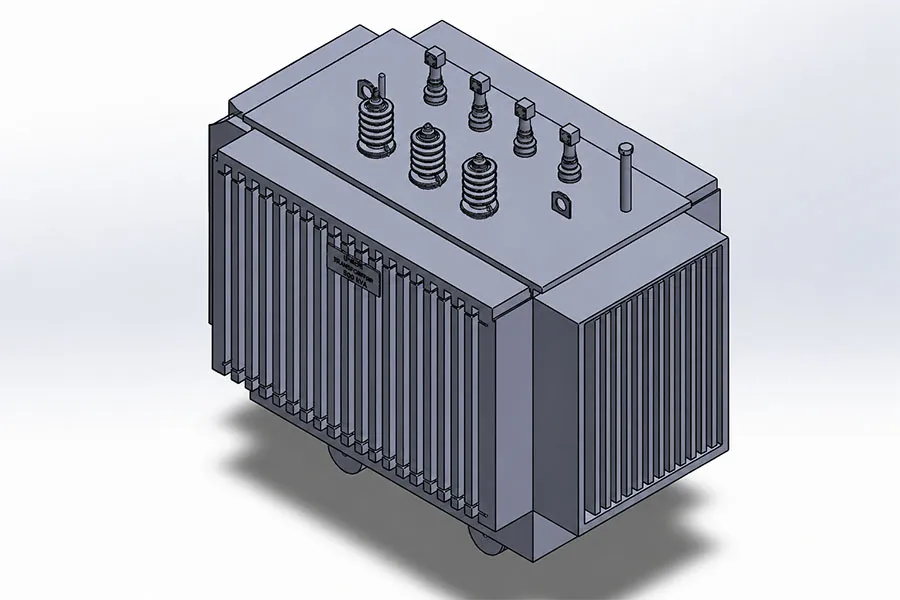
Huasheng’s oil-filled transformer range includes several capacities. Here’s how they’re typically used:
- 50 kVA: Small commercial and light industrial loads
- 100 kVA: Farms, workshops, small buildings
- 500 kVA: Commercial buildings, mid-size industrial
- 750 kVA: Larger industrial and mixed-load projects
- 1000 kVA: Large industrial plants, distribution substations, commercial infrastructure
Don’t assume the 1000 kVA loss table applies to other capacities. Each rating has its own design and loss values. Send your required capacity and get the corresponding technical data.
Read Related Article: Three-phase Transformer Buying Guide.
How should you order a 1000 kVA oil filled transformer?
Send the project data first and let the manufacturer match the design.
Step 1 — What electrical data should you submit?
- Rated capacity (1000 kVA)
- Primary voltage (e.g., 10 kV, 20 kV, 33 kV)
- Secondary voltage (e.g., 400 V, 415 V)
- Frequency (50 Hz or 60 Hz)
- Vector group (Dyn11, Yyn0, etc.)
- Impedance (if specified)
- Tap range
- Cooling method
- Insulation level
- Loss target
Step 2 — What site data should you submit?
Provide indoor or outdoor location, ambient temperature, altitude, humidity, salt or dust exposure, seismic data, foundation space, cable direction, destination country and required standard.
Step 3 — What will the manufacturer return?
The supplier should return a technical proposal, data sheet, drawing, accessory list, test plan, delivery schedule and commercial quotation. Review the proposal against the single-line diagram before approving production.
You do not need to select a model code alone. Send your voltage, frequency, load, site conditions and destination. Huasheng Transformer will review the design and prepare a project quotation.
Frequently asked questions
Q1: What Is the Price of a 1000 kVA Oil Filled Transformer?
For a 10 kV-class, 1000 kVA, three-phase, hermetically sealed standard configuration, the reference EXW price is about US$9,000–US$9,600. 20 kV, 35 kV, special efficiency ratings, copper windings, additional testing, and shipping will change the final quote.
Q2: What is a 1000 kVA Oil Filled Transformer Used for?
It is used for industrial plants, commercial infrastructure, utility substations, manufacturing facilities and large distribution systems.
Read Industrial Worshop Facilities Solutions, Transportation Infrastructure Solutions, Residential & Urban Distribution solutions
Q3: What’s the Difference Between Oil Filled and Oil Immersed Transformers?
In most overseas purchasing scenarios, these two terms refer to the same type of liquid-insulated transformer. This article uses “oil filled transformer” as the primary keyword and “oil immersed transformer” for semantic variation.
Q4: Can it operate at 50 Hz and 60 Hz?
It can be designed for either frequency, but the frequency must be confirmed before the core, losses and voltage ratio are finalized.
What Should Your Remember Before Ordering?
The best 1000 kVA transformer is the one that matches your project voltage, losses, environment, standard, transport plan, and total cost.
Here’s what to take away:
- 1000 kVA is capacity, not kW. Power factor matters.
- The series comparison (S11 through SH15) is mainly for 10 kV-class, three-phase, hermetically sealed units. Don’t apply it blindly to 20 kV or 35 kV.
- 20 kV and 35 kV need separate design confirmation. The insulation, losses, and dimensions all change.
- The main difference between S11, S13, S20, S22, and SH15 is the core material and no-load loss. Load loss stays roughly the same across the 10 kV series.
- The US$9,000–US$9,600 price is for a standard 10 kV reference configuration only. Your actual quote depends on voltage, materials, testing, and delivery terms.
Huasheng is a distribution transformer factory. Send your project inquiry details. The engineering team will review the application and prepare a project-based proposal.
Read Related Article:
- Single Phase Transformer Guide: Types, Applications, Sizing
- Padmount Transformer Guide: Types, Sizing, Specifications
- Top 16 Power Transformer Manufacturers in World